Baidu Unlimited-OCR Tops Hugging Face Trending: Is Traditional OCR Becoming Obsolete?
Editorial standards and source policy: Editorial standards, Team. Content links to primary sources; see Methodology.
Last checked: 2026-07-23
Baidu's baidu/Unlimited-OCR occupied the leading area of Hugging Face's trending model list when checked on July 23, 2026. The model API snapshot reported 2,237,351 downloads, roughly 2,776 likes in the approved capture, a July 21 last-modified timestamp, an MIT license, and the image-text-to-text pipeline tag. That is a dated attention signal. It is not an all-time download championship or evidence of enterprise market share.
The more durable story is the workflow. Unlimited-OCR is designed for one-shot, long-horizon document parsing, with official examples for multiple images and PDF pages, a max_length=32768 generation setting, and deployment routes for Transformers, vLLM, and SGLang. It can simplify experiments with long reports. It does not eliminate ingestion, page normalization, recovery, validation, security, or operations.
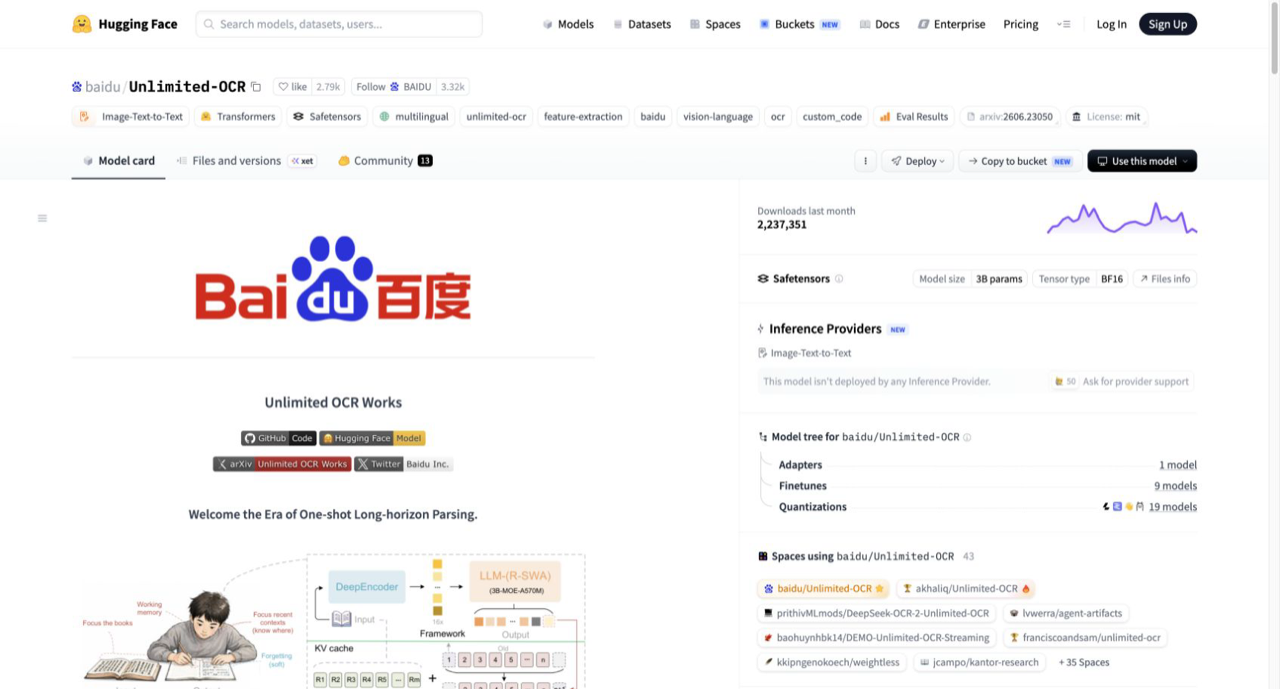
Source: Hugging Face model card, accessed July 23, 2026. The capture verifies published metadata and examples, not accuracy on a particular organization's documents.
Keep the trending snapshot separate from model facts
The Hugging Face API record is the machine-readable source for changing counters and tags. Likes had already moved from the approved 2,776 capture to 2,780 during a later check, which illustrates why the access time belongs beside a social metric. A publisher should retain the response rather than silently update a launch article every time the counter changes.
| Field | July 23 snapshot | Boundary | Action |
|---|---|---|---|
| Trending rank | Leading position in the dated list | Short-term velocity, not historical dominance | Add to an evaluation queue |
| Downloads | 2,237,351 | Hugging Face's counter, not unique users | Treat as an adoption signal |
| Likes | 2,776 approved snapshot; 2,780 on recheck | Continuously changing | Store timestamp and response |
| Last modified | July 21, 2026 | Repository activity, not necessarily retraining | Pin a commit |
| License | MIT | Model repository licensing | Review code and dependencies too |
| Weight size | About 6.77 GB | Download size, not peak VRAM | Measure on target hardware |
| Pipeline | image-text-to-text |
Interface category | Not a production SLA |
The model is tagged custom_code, and the official Transformers example enables trust_remote_code=True. An organization therefore needs a pinned revision, source review, restricted container, and dependency inventory even though the top-level license is permissive.
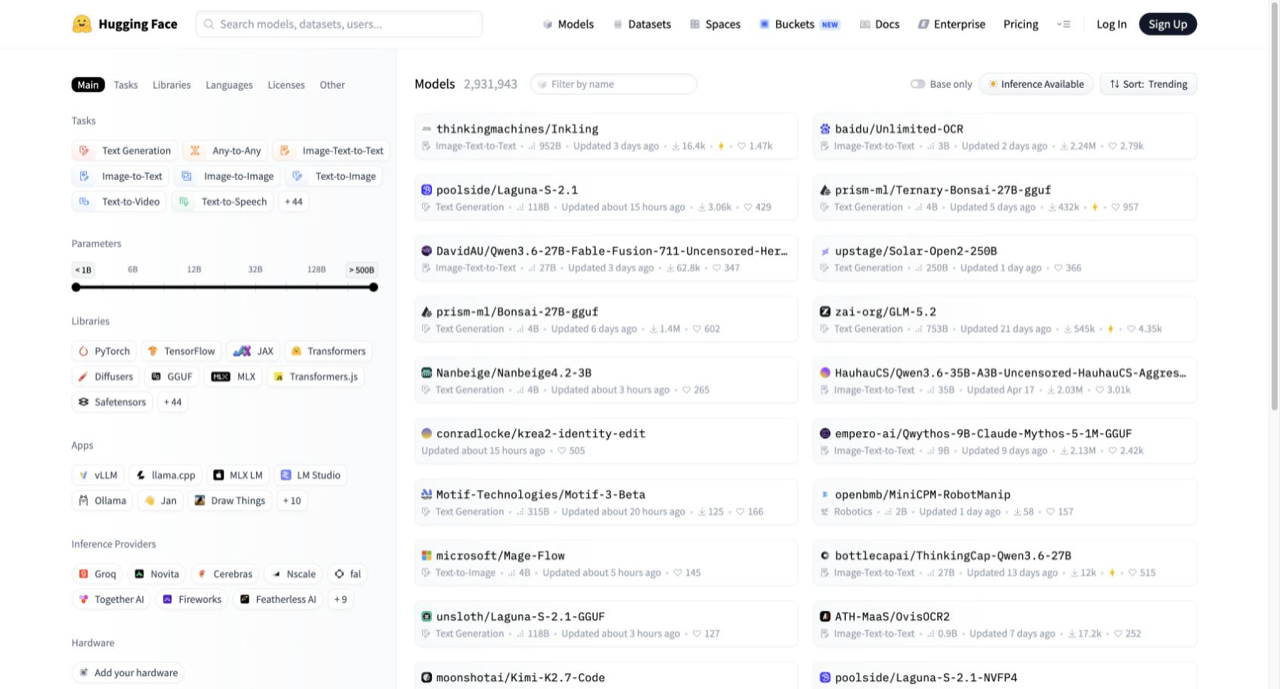
Source: Hugging Face trending models, accessed July 23, 2026. It establishes the observed list position only; ranking can change with time, region, and sorting.
What the 32K configuration actually says
The official repository describes one-shot long-horizon parsing and links the Unlimited OCR Works paper. Its tested Transformers environment uses Python 3.12.3 and CUDA 12.9, with pinned versions including torch 2.10.0, Transformers 4.57.1, and PyMuPDF 1.27.2.2. Single-image inference offers gundam and base configurations; multi-page and PDF examples use the 1024-pixel base mode.
max_length=32768 is a generation ceiling in the example, not a promise of unlimited pages. More pages introduce more text, table structure, headers, footnotes, and ordering decisions. The repository's no-repeat n-gram settings are decoding controls. They can reduce pathological repetition, but they do not prove that every line is present or every relationship is correct.
The paper's quality claims remain author-reported until reproduced. A production team should test its own languages, scanning conditions, layouts, and hardware. It should also decide how Markdown-like output maps into its database. Text that looks coherent can still contain a missing row, rewritten number, merged table, or incorrect reading order.
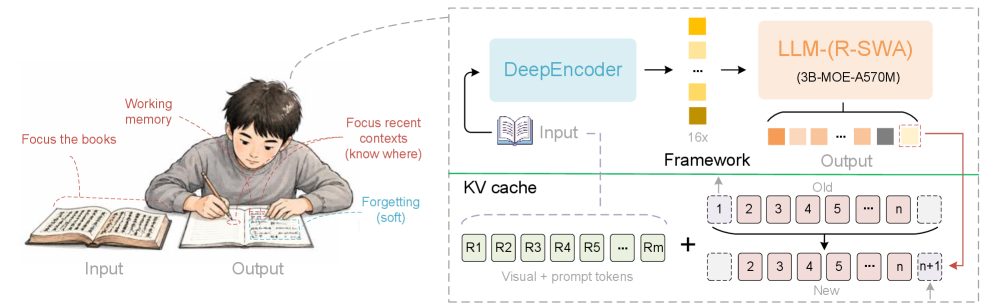
Source: Unlimited OCR Works, accessed July 23, 2026. The figure explains the authors' design and evaluation; it does not guarantee reproduction on arbitrary GPUs or scans.
A PDF workflow is larger than infer_multi
The reference code opens a PDF with PyMuPDF, renders every page at 300 DPI, writes sequentially zero-padded images such as page_0001.png, then submits the paths to multi-page inference. A real archive service also needs file hashing and malware checks, encrypted-PDF handling, pixel and page budgets, orientation detection, temporary-file cleanup, GPU scheduling, timeouts, failure isolation, and output lineage.
Page order should originate from the PDF index, not an incidental directory listing. Rotations must retain a transform back to original coordinates if reviewers need highlights. Long jobs need a recovery unit smaller than the source file. Reprocessing all 120 pages because page 93 failed wastes capacity and can produce a different answer for earlier pages.
A practical design creates chapter or page windows with a controlled overlap. Each window stores input hashes and output. The merge stage checks page numbers, removes duplicated headers, reconnects cross-page paragraphs, and refuses an incomplete sequence. “Unlimited” is a research direction; it is not an excuse to omit a bounded job model.
Is the traditional OCR stack obsolete?
A conventional system often separates layout detection, recognition, tables, reading order, post-processing, and field extraction. The stack is complicated, but each stage exposes a localized error and often produces coordinates and confidence values. It remains effective for stable forms, low-latency jobs, and processes built around field-level audit trails.
An end-to-end vision-language model can reduce handoffs and produce richer structure across pages. Its failures may also be broad and fluent: an omitted block, a paraphrased sentence, two merged tables, or a plausible but incorrect number. Those errors are harder to catch with a single scalar confidence score.
The near-term architecture is often hybrid. Unlimited-OCR proposes structure and long-range relationships. A conventional engine supplies character boxes and confidence. Rules compare totals, dates, identifiers, page counts, and critical fields. Public, low-risk material can use lighter review; contracts and financial records retain original images and human approval.
| Workload | Conventional advantage | Unlimited-OCR opportunity | Stop signal |
|---|---|---|---|
| Fixed invoices | Mature fields, coordinates, latency | Handling layout variation | Tax ID or total regression |
| Annual reports | Stable page-level extraction | Cross-page sections and tables | Wrong sequence or table total |
| Scanned archives | Established cleanup and dictionaries | Multilingual mixed layouts | Character error increases |
| Real-time mobile | Small models and predictable latency | Cloud batch processing | VRAM or latency exceeds SLA |
A 120-page bilingual annual report with tables, rotated pages, and recovery
An archive team freezes a 120-page Chinese-English annual report: 18 financial-table pages, nine scanned pages, six pages rotated by 90 degrees, and at least 240 footnotes. It stores the original PDF hash, every rendered-page hash, DPI, and orientation. The existing pipeline and Unlimited-OCR run on the same GPU class with fixed containers and parameters.
Acceptance metrics are operational rather than aesthetic. Character error must not exceed the baseline. Table-cell accuracy must reach 98%. All 120 pages must appear in order. Monetary columns must reconcile to source totals. Peak VRAM must stay inside reserved capacity, and elapsed time must remain below 1.5 times the baseline. The team forces a timeout at page 47 and verifies that only the affected window reruns and merges into the same final document.
Failure samples are labeled by mixed-language line, negative amount in parentheses, thousands separator, footnote marker, continued table header, rotation, omission, and duplication. Migration pauses if table accuracy falls by more than 0.5 percentage points, any page changes order, three consecutive documents run out of memory, or recovery creates a duplicate or missing page.
Deployment and security limits
The roughly 6.77 GB weight download is not a VRAM requirement. Runtime memory includes weights, activations, image inputs, KV cache, and framework overhead. High-resolution multipage jobs, 32K generation, and concurrency raise the requirement. The tested software matrix is a starting point, not a compatibility warranty. The vLLM recipe provides dedicated images, while SGLang uses repository-specific installation instructions; upgrades need regression tests.
Remote model code, PDF parsers, and untrusted uploads also create a security boundary. Run with outbound network disabled by default, a read-only pinned model snapshot, page and pixel limits, isolated temporary storage, and explicit log retention. Sensitive documents require a policy for cached pages and failed examples, not just an inference endpoint.
Teams comparing document systems can use RadarAI's multimodal RAG upgrade framework to translate public momentum into a repeatable acceptance suite.
FAQ
Is Unlimited-OCR the most-downloaded model ever on Hugging Face?
No such claim is made here. “Tops trending” describes a dated ranking snapshot. The download count is recorded under Hugging Face's own metric definition.
Does 32K mean it can process any number of pages?
No. max_length=32768 is an output-generation setting. Page count, resolution, structure, memory, and recovery constraints still apply.
Does the model accept PDF files directly?
The official example renders PDF pages to images with PyMuPDF at 300 DPI and then calls multi-page inference. A production service must add validation, rotation handling, scheduling, cleanup, and recovery.
Why retain a conventional OCR path?
It offers useful coordinates, confidence, predictable performance, and localized errors. A hybrid comparison can detect fluent VLM omissions and numerical mistakes before migration.
Can a company deploy it commercially?
The model card states MIT, but approval also depends on custom-code review, dependency licenses, data policy, infrastructure, and the organization's own risk assessment.
Sources
- Hugging Face model card: baidu/Unlimited-OCR, accessed July 23, 2026.
- Hugging Face model API, accessed July 23, 2026.
- Baidu Unlimited-OCR repository, accessed July 23, 2026.
- Unlimited OCR Works paper, accessed July 23, 2026.
- vLLM Unlimited-OCR recipe, accessed July 23, 2026.
Related reading
- Qwen API pricing and access for builders: verify the model, region, and real test cost
- MiniMax long-context API evaluation: test evidence retrieval before trusting the window size
- GLM coding API evaluation for builders: test one repository patch with diff, tests, and rollback
- Cloudflare Pay Per Crawl test guide: what publishers and AI crawlers can verify in private beta
RadarAI helps builders track AI updates, compare source-backed signals, and decide which changes are worth acting on.