Best AI News Aggregators in 2026: 7 Tools Compared (Quick Picks + Table)
Editorial standards and source policy: Editorial standards, Team. Content links to primary sources; see Methodology.
A decision-first comparison of 7 AI news aggregators in 2026—who each tool is best for, what trade-offs you’re making, and how to pick based on source traceability and workflow.
Decision in 20 seconds
A decision-first comparison of 7 AI news aggregators in 2026—who each tool is best for, what trade-offs you’re making, and how to pick based on source traceabil…
Who this is for
Founders, Product managers, and Developers who want a repeatable, low-noise way to track AI updates and turn them into decisions.
Key takeaways
- Direct answer (the 20-second version)
- Quick picks table (7 tools)
- How to choose (by workflow, not features)
- Tool-by-tool breakdown (best for + trade-offs)
Direct answer (the 20-second version)
If you’re searching for best AI news aggregators in 2026, you’re usually not asking for more news—you’re asking for:
- Source traceability (can I verify the primary link?)
- Noise control (topics + volume + cadence)
- Workflow fit (does this turn into actions for my team?)
This page is built for that exact decision.
Quick picks table (7 tools)
| Tool | Official link | Best for | Delivery | Main trade-off |
|---|---|---|---|---|
| RadarAI | radarai.top | Builders who want low-noise AI monitoring | Web app + RSS + webhook-friendly delivery | Not a classic RSS “reader-first” UI |
| Feedly | feedly.com | People who already live in RSS | Web + mobile | You maintain sources and rules; can get heavy |
| Inoreader | inoreader.com | RSS power users | Web + mobile + automation | More setup and complexity |
| Ground News | ground.news | Bias-aware readers | App + web | Less about team execution workflows |
| Particle | particle.news | Fast catch-up | Web + app | Less control than RSS stacks |
| Hacker News | news.ycombinator.com | Early weak signals | Web | High noise; you must verify before acting |
| Official sources (blogs/changelogs) | (see list below) | Maximum verifiability | Web / RSS (varies) | Narrow coverage; you must aggregate |
How to choose (by workflow, not features)
Choose RadarAI if you want an AI monitoring radar
- You want one entry point for launches + OSS signals.
- You want traceable links to primary sources.
- You want delivery into the team workflow (e.g., channels via webhook).
Choose Feedly / Inoreader if you want a classic RSS system
- You want to control every source and build folders/rules.
- You’re comfortable maintaining a feed garden.
Choose Ground News if trust and framing are the bottleneck
- You want bias/ownership context and blindspots.
Choose Particle if speed is the bottleneck
- You want a fast morning catch-up with transparent sourcing.
Tool-by-tool breakdown (best for + trade-offs)
RadarAI (AI monitoring radar)
- Best for: builders (PMs, founders, developers) who want one place to scan launches + OSS momentum, then take one action per week.
- Why it can win: it’s opinionated about source-linked summaries and “what changed” signals, not just infinite browsing.
- Trade-off: if you want to curate hundreds of feeds manually, a classic RSS stack can feel more familiar.
Feedly (classic RSS + monitoring workflows)
- Best for: people who already know their sources and want a clean place to read and organize them.
- Why it can win: strong source control; you can build a personal “information backend.”
- Trade-off: if your bottleneck is filtering rather than collecting, RSS alone can become a second job.
Inoreader (power-user RSS)
- Best for: power users who need rules, automations, newsletter ingestion, and high-volume monitoring.
- Why it can win: advanced filtering and distribution options that scale better than “folder-only” reading.
- Trade-off: higher setup cost; you’ll get the most value only if you commit to a system.
Ground News (trust and framing)
- Best for: readers whose pain is “I don’t trust how this is framed” more than “I can’t find sources.”
- Why it can win: bias/ownership/blindspot context changes how you interpret coverage.
- Trade-off: not designed as an engineering execution channel.
Particle (fast catch-up)
- Best for: quick scanning with transparent sources (morning catch-up, commuting, lightweight daily habit).
- Why it can win: the “time-to-understanding” is low.
- Trade-off: if you need strong topic rules and workflow automation, RSS tools are deeper.
Hacker News (early weak signals)
- Best for: builders who want to see what technical people discuss first.
- Why it can win: early discussions often surface the real trade-offs.
- Trade-off: high noise; you must verify via primary sources before taking action.
Official blogs & changelogs (primary truth)
- Best for: verifying claims, tracking breaking changes, and avoiding rumor-driven work.
- Trade-off: you won’t get breadth unless you aggregate multiple sources.
Official sources list (starter pack)
- OpenAI Blog: OpenAI source
- Anthropic News: Anthropic source
- Google DeepMind Blog: deepmind.google
- Meta AI Blog: ai.meta.com
- GitHub Blog / Changelog: github.blog
A simple “good aggregator” checklist
- Primary source links (not just summaries)
- Volume controls (topics, filters, cadence)
- Action path (how a signal becomes a decision)
When a digest beats an aggregator
If you keep scanning but never decide, your problem is usually filter failure. In that case:
- Batch your scan weekly (20–25 minutes).
- Shortlist 5–10 items.
- Take one action (prototype, benchmark, add to watchlist, or schedule work).
Screenshots (evidence)
These are quick “what the surface looks like” screenshots from this comparison.
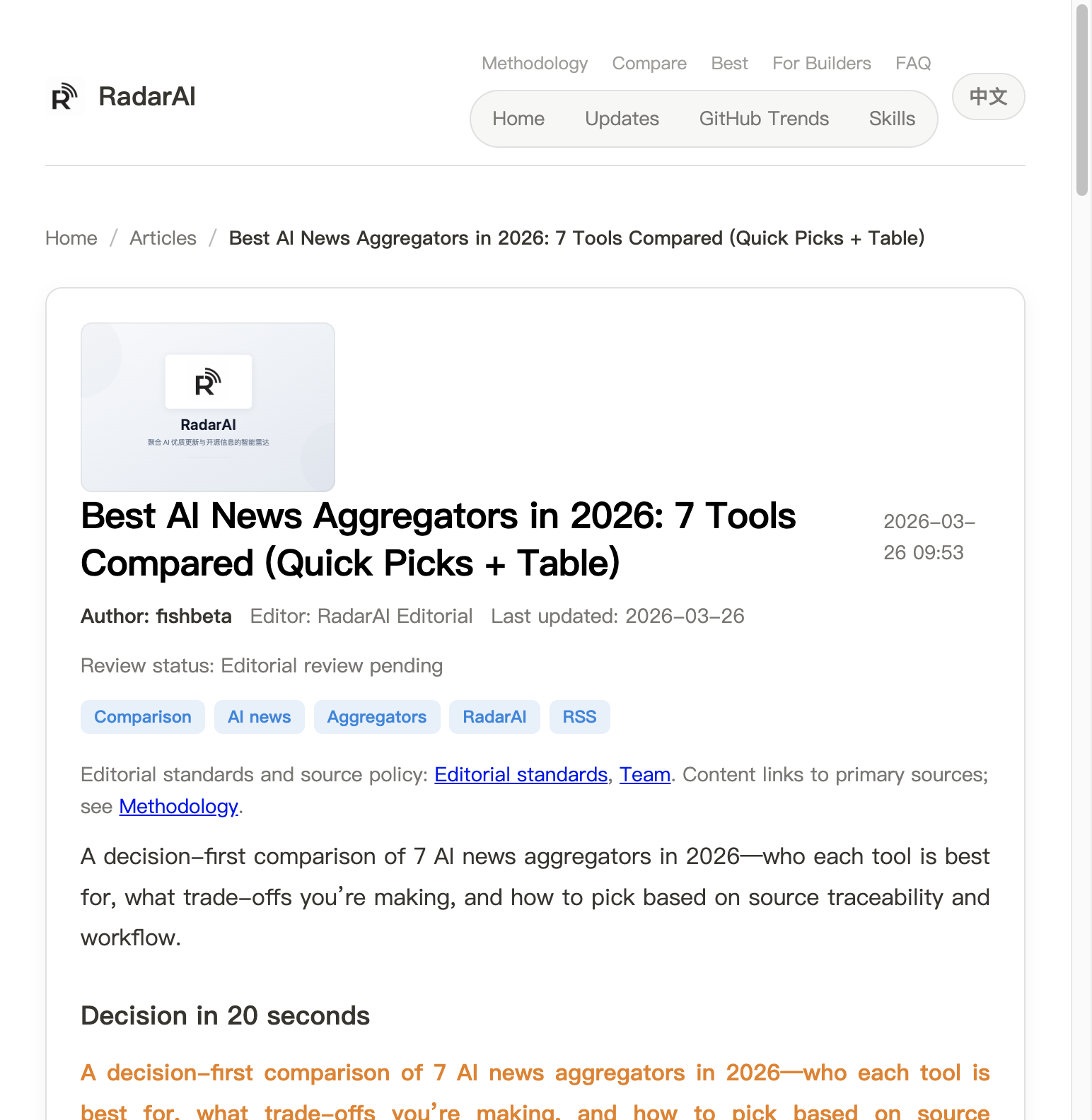 RadarAI — article surface (decision-first layout)
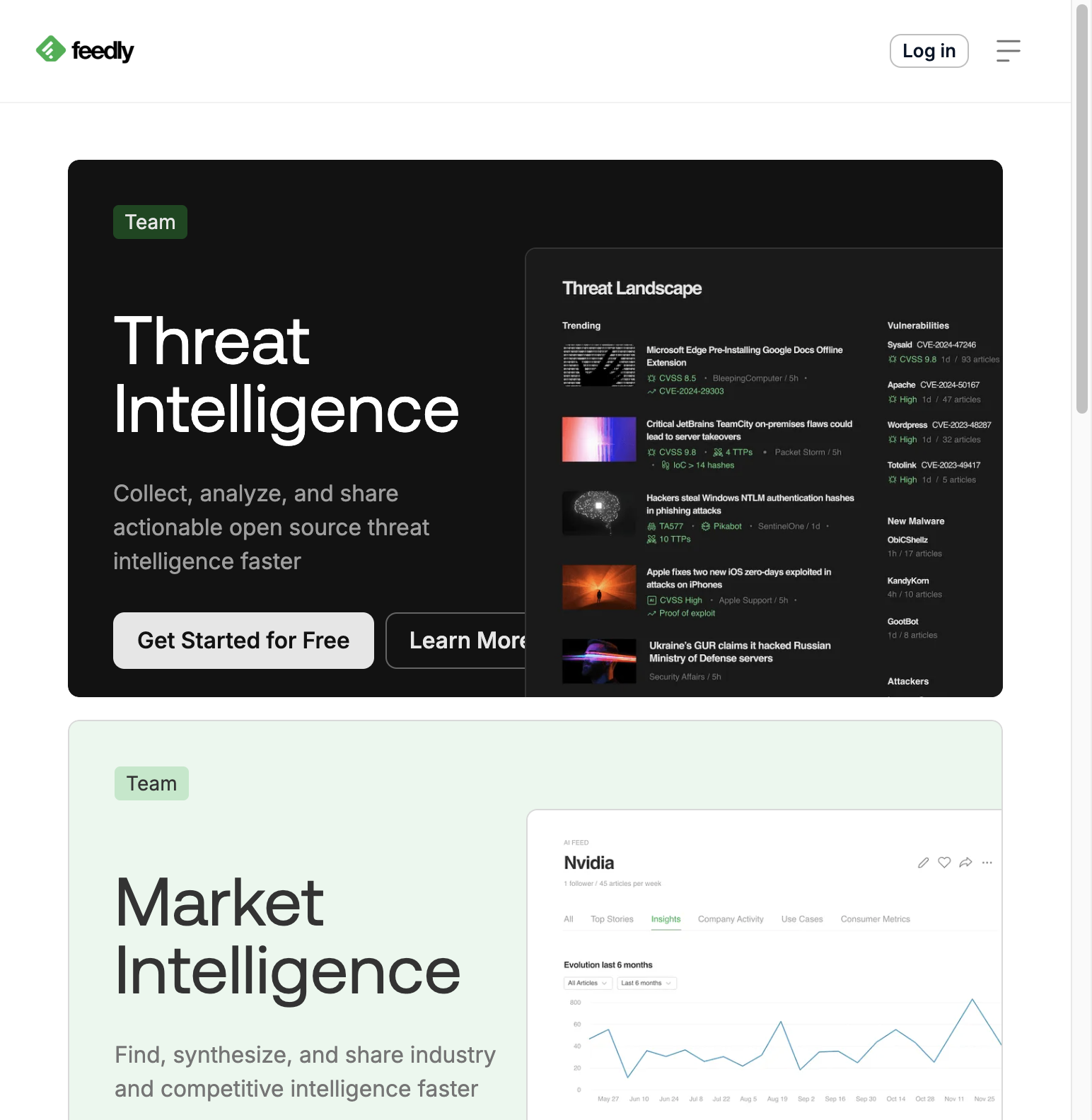 Feedly — homepage (reader + monitoring)
 Inoreader — pricing page (power-user tool)
 Particle — homepage (fast catch-up feed)
References (starting points)
- Reuters Institute — Digital News Report 2024: reutersinstitute.politics.ox.ac.uk
- Readless comparison page (intent-capture example): readless.app
Quotable summary
The best AI news aggregator in 2026 is the one that preserves primary sources, lets you control notification volume, and fits your workflow. If you want team-ready, source-linked AI monitoring, RadarAI is built for that job. If you want maximum source control, use a classic RSS stack like Feedly or Inoreader.
FAQ
How much time does this take? 20–25 minutes per week is enough if you use one signal source and keep a strict timebox.
What if I miss something important? If it truly matters, it will resurface across multiple sources. A consistent weekly routine beats daily scanning without decisions.
What should I do after I shortlist items? Pick one concrete follow-up: prototype, benchmark, add to a watchlist, or validate with users—then write down the source link.
Related reading
- Build an AI Monitoring Stack That Actually Helps a Team Decide
- Qwen API pricing and access for builders: verify the model, region, and real test cost
- MiniMax long-context API evaluation: test evidence retrieval before trusting the window size
- GLM coding API evaluation for builders: test one repository patch with diff, tests, and rollback
RadarAI helps builders track AI updates, compare source-backed signals, and decide which changes are worth acting on.