code-review-graph Cuts AI Review Context by 82x: Why the Open-Source Tool Is Surging
Editorial standards and source policy: Editorial standards, Team. Content links to primary sources; see Methodology.
Last checked: 2026-07-23
tirth8205/code-review-graph had roughly 25,554 GitHub stars and 2,404 forks in a July 23, 2026 API snapshot. The MIT-licensed Python project has a crisp pitch: build a local structural map once, then give an AI reviewer the files and relationships relevant to a change instead of repeatedly loading broad slices of the repository.
Its headline result is an approximately 82x median reduction in per-question context across six open-source repositories. That is the repository's benchmark, not an independent RadarAI measurement of agent spending. It compares a whole-source-corpus token baseline with the response from a graph query. A competent agent normally searches identifiers and opens a few likely files, so teams should not convert 82x into a promised 98.8% bill reduction.
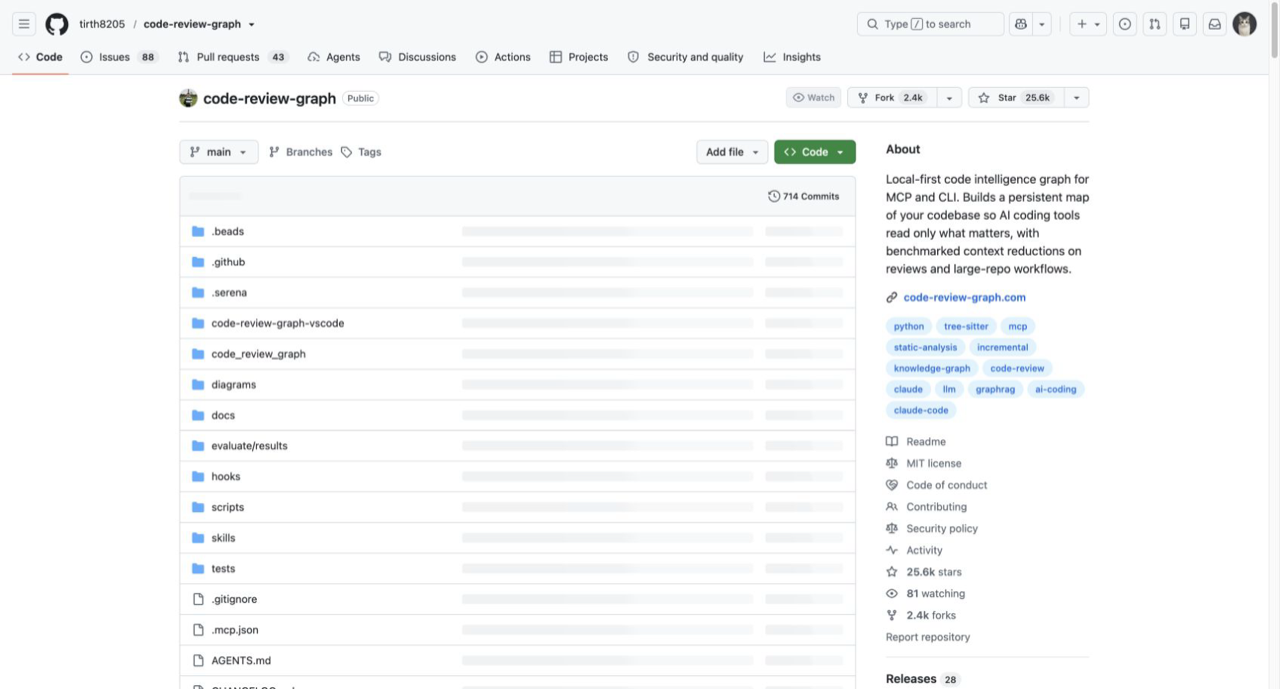
Source: code-review-graph repository, accessed July 23, 2026. It verifies public project metadata and momentum, not savings on a reader's repository.
What the project installs
The package requires Python 3.10 or newer. The quick path is pip install code-review-graph, followed by code-review-graph install and code-review-graph build. The installer can detect Codex, Claude Code, Cursor, Windsurf, Gemini CLI, Qwen, Qoder, Kiro, GitHub Copilot, and other supported clients, or target one platform explicitly with flags such as --platform codex.
The PyPI release supplies the package, while the usage guide describes CLI and MCP workflows. Automatic integration is convenient but also means evaluators should inspect which MCP files, hooks, skills, and repository rules change.
| Adoption question | Available evidence | Main risk | Decision gate |
|---|---|---|---|
| Does it reduce context? | Project reports an ~82x six-repo median | Whole-corpus baseline is generous | Compare with ordinary search |
| Does it preserve recall? | Recall 1.0 on graph-derived ground truth | Predictor and labels share the graph | Score against known PR defects |
| Is it local? | Tree-sitter and SQLite are core | Optional embedding providers can be remote | Disable cloud providers and inspect traffic |
| Does it help small changes? | Graph adds impact edges and snippets | One-file edits may cost more than the diff | Segment by PR size |
| Is setup cheap? | One-command multi-client installer | Index and configuration require upkeep | Trial one client in a repository copy |
Reconstructing the 82x benchmark
The repository pins six real projects and asks several representative codebase questions, such as where authentication works or which file is the main entry point. The naive side counts every source token. The graph side returns roughly 2,000 to 3,500 tokens of search results and neighboring edges. Reported ratios range from 38x to 528x, with a median near 82x. The 528x value belongs to FastAPI and is the maximum, not the typical headline.
Representative table entries include about 951,071 corpus tokens versus 2,169 graph tokens for FastAPI; 208,821 versus 2,495 for code-review-graph itself; 125,022 versus 1,986 for Flask; and 89,492 versus 2,438 for HTTPX. Pinned upstream commits, a fixed community-detection seed, and deterministic CPU embeddings make the automated run repeatable. The reproduction guide lists configs and expected artifacts.
The denominator is the caveat. Real reviewers rarely read a million-token corpus to answer a narrow question. They use file names, ripgrep, symbols, language servers, or repository instructions. The project openly calls whole-corpus reading an upper bound and includes an agent_baseline using pure-Python grep and the top three files by match count. That should be the main comparison in an adoption study.
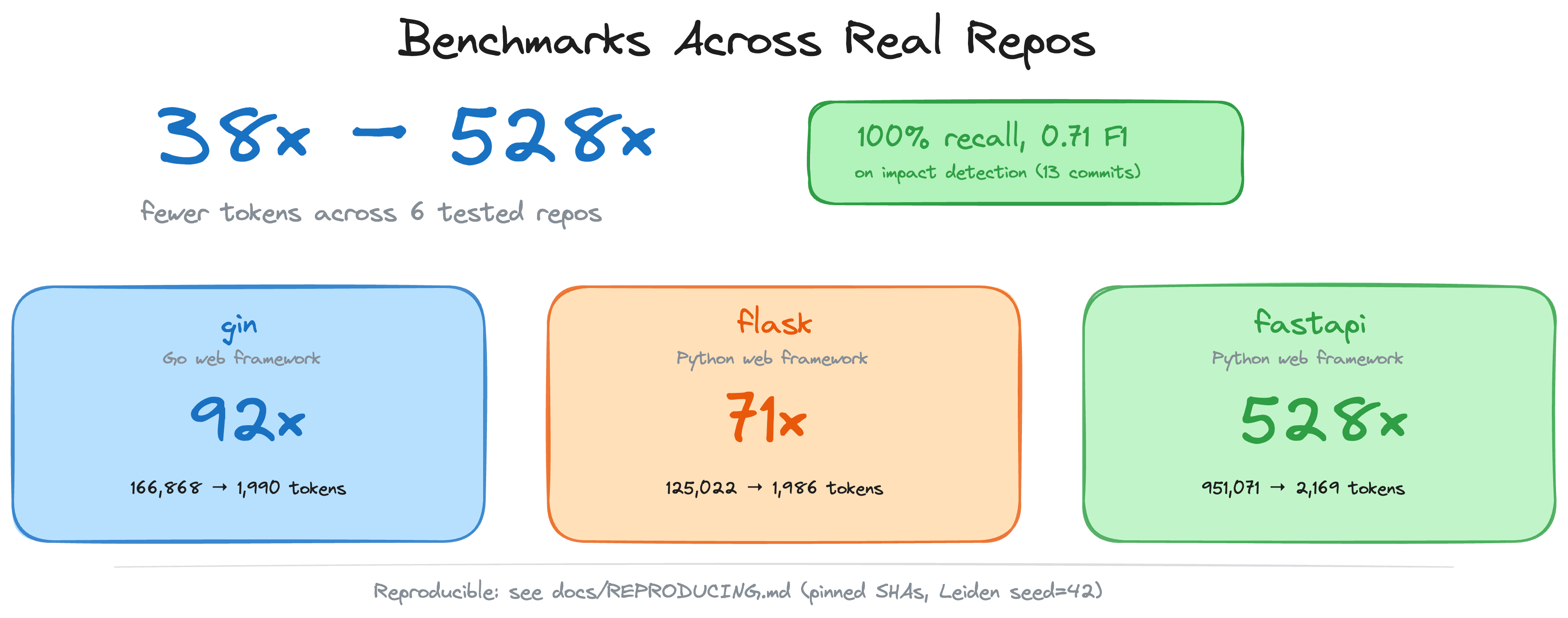
Source: the project's benchmark board, accessed July 23, 2026. It documents the authors' method and numbers; it is not an independent measurement of a production agent bill.
Tree-sitter, SQLite, and blast radius
The system parses abstract syntax trees with Tree-sitter and records functions, classes, imports, calls, inheritance, tests, and related structure as graph nodes and edges. SQLite stores the result locally. SHA-256 checks identify changed files so incremental updates can reparse a smaller set. At query time, search, neighbors, communities, execution flows, and blast-radius traversal propose a review set.
The added value over text search is relational. A changed public method may affect callers, implementations, and tests whose files do not share the same issue wording. This is most useful for shared interfaces and cross-layer changes. For a comment, spelling fix, or isolated leaf function, the graph response can exceed the tiny diff it was meant to explain.
“Local-first” describes the core parser and database, not every optional setting. Semantic search can use local sentence transformers or providers such as Gemini, MiniMax, and OpenAI-compatible endpoints. Enabling a hosted embedding service may change the source-code boundary. Organizations should test the exact config with outbound networking blocked or observed.

Source: project architecture material, accessed July 23, 2026. It explains the intended pipeline, not complete coverage of reflection, dynamic dispatch, generated code, or every framework convention.
A bounded MCP trial
A conservative installation looks like this:
pipx install code-review-graph
code-review-graph install --platform codex
code-review-graph build
code-review-graph status
The client can then request review context, impact, execution flows, or knowledge gaps over MCP. Pin the package version, retain the generated configuration diff, and treat .code-review-graph/ as rebuildable derived data. Test the installer in a copy before allowing automatic discovery to touch several clients.
Repository claims such as a roughly ten-second first build for 500 files and sub-two-second incremental work on a 2,900-file project are useful planning clues, not service guarantees. Measure initial indexing, update latency, cache invalidation, and CI time on the target monorepo.
Why the recall result is circular
The project reports recall 1.0 and average F1 around 0.714 against a graph-derived ground truth. The label set includes changed files and files with graph call or import edges into them, while the predictor walks the same graph. Recall 1.0 is therefore a circular upper bound, not independent proof that the tool never misses an affected file. The README states this limitation; downstream articles should retain it.
Independent evidence can come from files actually co-changed in historical commits, known review findings, incident fixes, or human-labeled dependencies. Other published weaknesses, including search MRR around 0.35 and flow-detection recall around 33%, suggest the graph may miss framework conventions, reflection, string registration, and dynamic routing. Conservative impact traversal can also increase false positives.
Twelve fixed pull requests reviewed with search and the code graph
A maintainer freezes 12 merged pull requests with known outcomes: four single-file fixes, four cross-module features, two public-API changes, and two test or configuration changes. Each task starts from the pre-merge commit with original review comments hidden. One lane gives the same AI ordinary identifier search and file reads. The second adds code-review-graph. Model, prompt, token ceiling, permissions, and acceptance commands remain identical.
For each lane, the team records input and output tokens, files opened, graph build and update time, known defects found, false positives, missed dependencies, reviewer minutes, and final disposition. The graph lane passes only if defect recall is no worse than search and median context falls by at least 30% on cross-module PRs. Installation and indexing must amortize within 20 PRs.
The trial pauses on any missed high-severity dependency, a 20% increase in human review time from false positives, two stale-index events, or a pattern where small PRs consistently consume more context. A useful outcome may be selective use for high-coupling changes rather than a universal default.
Limitations and fit
Static syntax does not fully represent dynamic imports, dependency injection, reflection, templates, code generation, runtime routing, or cross-language RPC and schema relationships. SQLite is straightforward, but very large repositories, concurrent updates, and several worktrees need direct testing.
The best early adopters maintain large modular codebases and already own a review baseline. A tiny repository without labeled review outcomes has less to gain and no way to verify the headline. RadarAI's AI coding-workflow guide provides a broader framework for tool roles and review effort.
FAQ
Is 82x a measured production token saving?
No. It is the repository benchmark's median ratio between whole-corpus tokens and graph-query tokens across six projects. Compare it with normal search in your own agent workflow.
Why not headline 528x?
That is the single maximum for FastAPI. The project correctly presents approximately 82x, the six-repository median, as the headline.
Does the tool upload source code?
Core parsing and SQLite storage are local. Optional remote embedding providers can change that boundary, so review the exact configuration and network traffic.
Does recall 1.0 mean it cannot miss a file?
No. The result uses graph-derived labels and a graph-based predictor. Historical defects, co-change records, and human labels are better independent tests.
Should every pull request use it?
Not automatically. Cross-module changes may benefit most, while small single-file edits can carry more structural overhead than value. Segment the trial.
Sources
- tirth8205/code-review-graph, accessed July 23, 2026.
- Benchmark reproduction guide, accessed July 23, 2026.
- Usage documentation, accessed July 23, 2026.
- code-review-graph on PyPI, accessed July 23, 2026.
- Tree-sitter, accessed July 23, 2026.
Related reading
- Qwen API pricing and access for builders: verify the model, region, and real test cost
- MiniMax long-context API evaluation: test evidence retrieval before trusting the window size
- GLM coding API evaluation for builders: test one repository patch with diff, tests, and rollback
- Cloudflare Pay Per Crawl test guide: what publishers and AI crawlers can verify in private beta
RadarAI helps builders track AI updates, compare source-backed signals, and decide which changes are worth acting on.