CXMT's First-Day Valuation Above CNY 3 Trillion: Price, Intraday Move, and AI Memory Limits
Editorial standards and source policy: Editorial standards, Team. Content links to primary sources; see Methodology.
Last checked: 2026-07-27.
A CNY 3 trillion debut makes more sense when the numbers sit together
CXMT (688825.SH) opened far above its issue price on its first trading day. The issue price was CNY 8.66, the open was CNY 49.50, and the intraday range ran from CNY 38.11 to CNY 55.03. At 15:02, the shares were CNY 49.00, up 465.82% from the issue price. That quote implied total market capitalization of about CNY 3.277T and free-float market capitalization of about CNY 220.649B.
The timestamp and denominator matter. This is a July 27, 2026 intraday snapshot, not a final closing price. Total market cap values all shares at the quoted price; free-float cap covers only shares available for trading.
| First-day figure | Value | How to read it |
|---|---|---|
| Issue price | CNY 8.66 | Baseline for the first-day gain |
| Opening price | CNY 49.50 | 471.59% above the issue price |
| Intraday high / low | CNY 55.03 / CNY 38.11 | A wide range showing substantial price disagreement |
| 15:02 price | CNY 49.00 | Up 465.82%; still not a closing price |
| Total market cap | About CNY 3.277T | All shares valued at the quoted price |
| Free-float market cap | About CNY 220.649B | Tradable shares only |
| IPO proceeds | CNY 57.92B | Capital raised in the offering, not market value |
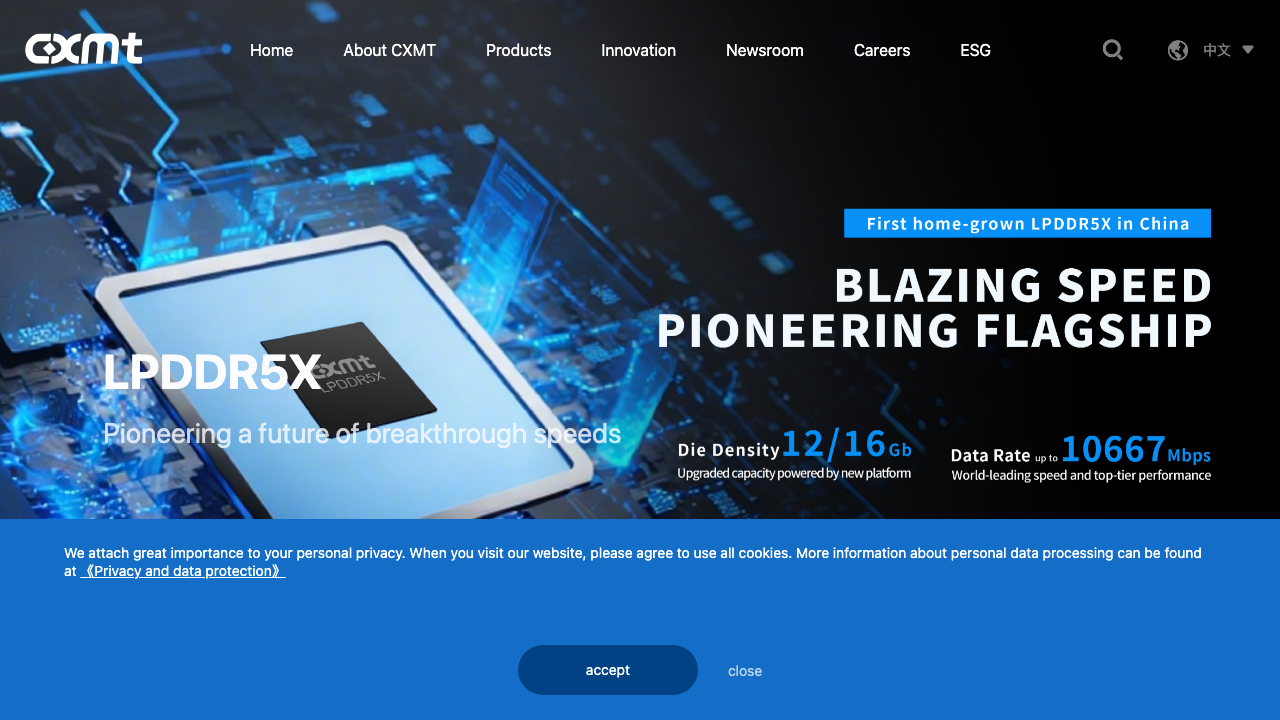
Source image: CXMT's official English homepage, accessed 2026-07-27. The page displayed LPDDR5X product information on that date; timestamped market sources provide the trading figures.
Why total and free-float value are so different
Total market cap applies the current share price to every share. Free-float cap applies it only to shares available in the market. When the tradable pool is small, a limited amount of buying can move the quoted price and therefore revalue the entire company on paper.
Dividing total market cap by the snapshot price gives an arithmetic estimate of about 66.88B total shares. Doing the same with free-float cap gives roughly 4.50B tradable shares. Those calculations help explain scale; official capital filings remain the legal source for share counts.
A market-cap sensitivity check explains the volatility
Those arithmetic share estimates support a simple market-cap sensitivity check. Each CNY 1 move in the quoted share price changes implied total market value by roughly CNY 66.88B, while free-float value changes by about CNY 4.50B. The nearly fifteen-fold gap is not a contradiction; it reflects how much of the company was not freely tradable at the time.
The first-day high and low can therefore produce huge swings in whole-company paper value even though trading occurs in the smaller float. The headline market cap is the marginal transaction price multiplied across all shares, not the amount someone paid to acquire the business. Comparisons also need a consistent denominator: total cap against total cap, or float against float.
IPO proceeds belong in a separate column. CNY 57.92B is capital raised for the company, while CNY 3.277T is a point-in-time market valuation that moves with the share price. The former changes available resources; the latter expresses market expectations.
The operating data are significant, but they describe a specific business
CNBC, citing the prospectus, reports a 7.67% global DRAM share for CXMT in 2025. DRAM is the working memory used by phones, PCs, and servers while they are running. The report also gives first-quarter operating profit of CNY 35.43B, compared with a CNY 2.83B loss a year earlier. The figures show a memory producer with real scale and a sharp operating change.
They do not by themselves establish HBM supply. HBM is stacked, high-bandwidth memory placed close to AI accelerators, with a different product form, packaging process, and customer qualification path from commodity DRAM. LPDDR5X is designed for low-power mobile devices. DRAM market share is not HBM market share.
Procurement case: 64 inference servers
Consider a buyer planning 64 dual-socket servers with 1.5TB of DRAM each. CXMT's share price cannot answer whether it belongs on the approved supplier list. Procurement needs formal part numbers at the target density, a delivery schedule, platform-compatibility evidence, and testable samples.
Start with a limited stability run on identical samples. Record correctable and uncorrectable memory errors, restarts, down-clocking, and firmware differences per server. Expand only when capacity, delivery, compatibility, and error-rate acceptance are all satisfied. Pause if the target-density DIMM is unavailable, delivery has no schedule, or mobile-memory marketing is offered in place of server qualification material.
This process neither assumes CXMT cannot qualify nor treats a strong debut as proof that it already has. It converts a capital-market signal into supply questions a procurement team can answer.
What the debut really tells us
The valuation shows extraordinary market attention toward China's domestic DRAM capacity. The CNY 57.92B offering also gives the company substantial new resources. Whether that attention turns into AI-server or HBM supply depends on product, qualification, customer, and delivery evidence that must be tracked separately from the first-day quote.
Official and Firsthand Sources
Related reading
- Qwen API pricing and access for builders: verify the model, region, and real test cost
- MiniMax long-context API evaluation: test evidence retrieval before trusting the window size
- GLM coding API evaluation for builders: test one repository patch with diff, tests, and rollback
- Cloudflare Pay Per Crawl test guide: what publishers and AI crawlers can verify in private beta
RadarAI helps builders track AI updates, compare source-backed signals, and decide which changes are worth acting on.