Liang Wenfeng's Latest Talk: DeepSeek Targets 10-Month API Payback and Puts Coding Agents First
Editorial standards and source policy: Editorial standards, Team. Content links to primary sources; see Methodology.
Last checked: 2026-07-23
On July 23, the account @falali2015 published an X Article titled 梁文锋投资者交流会(完整版全文), or “Liang Wenfeng investor exchange, complete transcript.” It is a third-party transcript publication, not a DeepSeek newsroom post, audited financial disclosure, or company-certified transcript. Two statements attributed to Liang drive the headline: API pricing is designed to recover purchased equipment cost in roughly ten months, and coding agents are the current first priority among agent directions.
Those are important management signals if the transcript is accurate. They are not a recognized revenue metric or a product release. The useful response is to convert each statement into a dated monitoring item and require confirmation from DeepSeek pricing, documentation, repositories, technical reports, or formal disclosures before procurement changes.
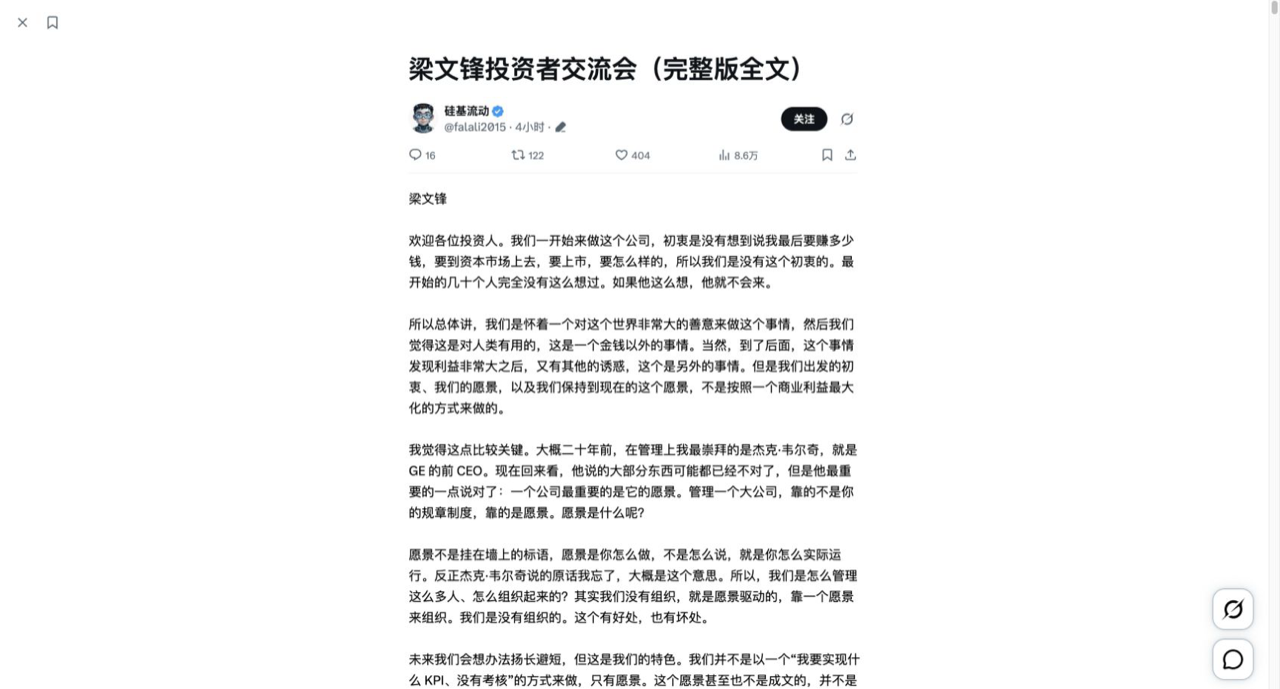
Source: X Article by @falali2015, published and accessed July 23, 2026. It establishes the third-party article's title, account, and presented text; it does not establish DeepSeek's official approval of every sentence.
Start with provenance, not interpretation
This article uses three evidence levels. Level A is current first-party material from DeepSeek: API models, prices, documentation, changelog, and the official GitHub organization. Level B is wording directly attributed to Liang in the supplied transcript. Level C is analysis derived from that wording, such as an interpretation that low pricing forms a moat or that a particular parameter count will ship. Level B can be quoted with attribution. Level C cannot be backfilled into the transcript as fact.
| Signal | Current source | Evidence level | Responsible action | Unsupported action |
|---|---|---|---|---|
| Ten-month API payback | Third-party transcript attributes it to Liang | B: awaits official financial evidence | Build a sensitivity model | Record audited profitability |
| Coding agent priority | Third-party transcript | B: roadmap signal | Monitor official products and integrations | Announce a released product |
| Current API models and prices | DeepSeek pricing docs | A: dated public snapshot | Budget real calls | Infer the company's entire cost base |
| Open source as strategic restraint | Transcript plus observable official repositories | B with partial A corroboration | Track commits and licenses | Promise every future model will be open |
| TileLang and 1%-2% loss | Transcript; public TileLang project | B: adoption and metric need confirmation | Wait for first-party benchmark evidence | Treat as production SLA |
| 150B-250B activated parameters | Forward-looking transcript discussion | B: watch only | Record as an open question | Publish as a released specification |
Ten-month payback is a pricing rationale, not a public income statement
The transcript attributes a specific pricing philosophy to Liang: API rates are set with an aim of recovering purchased equipment cost in around ten months. If accurate, that suggests a connection to infrastructure cash recovery rather than a fixed percentage discount to competitors. It does not tell us which accelerators, utilization, depreciation, electricity, networking, data-center, engineering, support, tax, or distribution costs are in the calculation. “Payback” could also refer to a hardware batch rather than the company.
The official DeepSeek pricing page showed deepseek-v4-flash and deepseek-v4-pro on July 23, with a 1M context and 384K maximum output. Per million tokens, cache-hit input was listed at $0.0028 and $0.003625, cache-miss input at $0.14 and $0.435, and output at $0.28 and $0.87. Concurrency limits were 2,500 and 500. The page also said deepseek-chat and deepseek-reasoner would be deprecated on July 24 at 15:59 UTC and mapped to the new model modes.
Those facts corroborate the current public offer, not the ten-month formula. An enterprise budget needs its own cache hit rate, input-output shape, concurrency, retries, tool loops, and reviewer time. Applying the extremely low cache-hit rate to every input token would produce a misleading forecast.
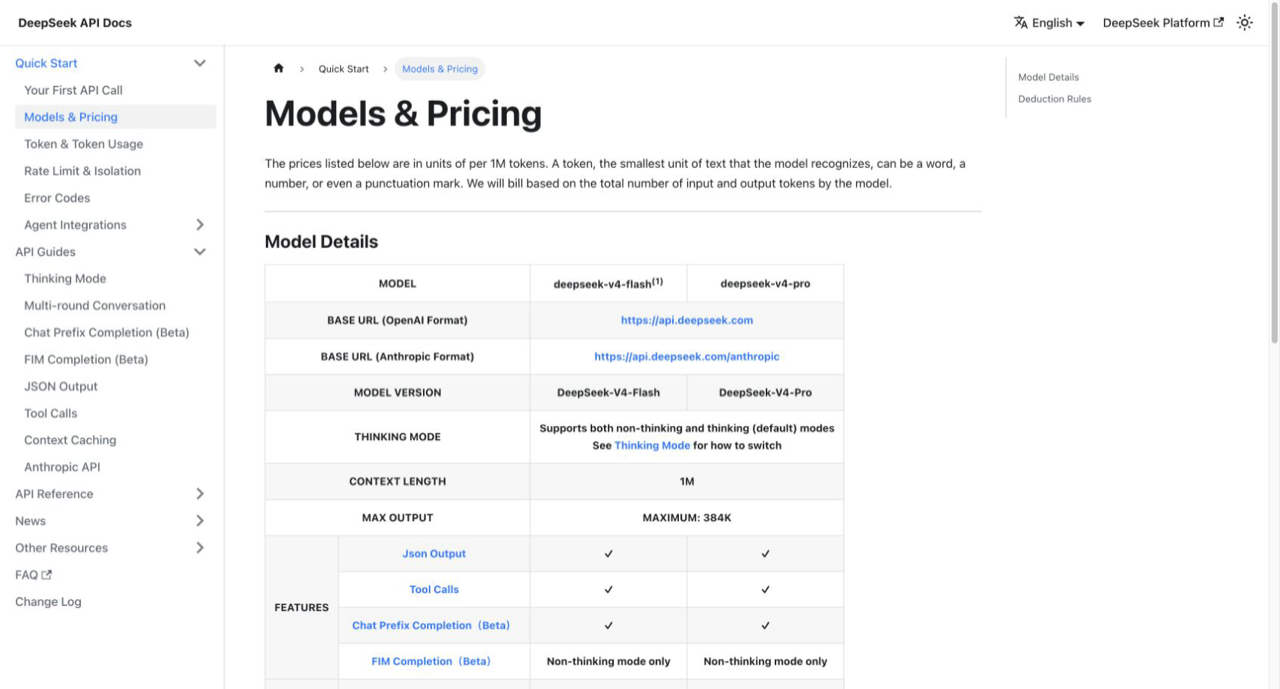
Source: DeepSeek API Models & Pricing, accessed July 23, 2026. It verifies current IDs, limits, prices, and concurrency; it does not verify the attributed ten-month equipment-payback accounting.
What “coding agents first” would need to become
The transcript describes coding agents as the highest-priority agent direction. That may influence investment in code quality, repository navigation, tool use, long tasks, parallel work, patch validation, and context caching. The eventual surface could be an API, CLI, IDE integration, model, or open-source harness. None of those product forms can be announced from the transcript alone.
A buyer can prepare a fixed 20-task repository benchmark now: ten bugs, five cross-file features, and five maintenance tasks. Record acceptance-command success, regressions, unrelated diff, tool calls, cache behavior, total tokens, retries, and reviewer minutes. When a DeepSeek coding product appears, place it in the same task set rather than lowering the bar because leadership reportedly prioritized the area.
The DeepSeek API changelog is a formal product surface. A signal moves from watch to test only when an official entry supplies a callable model or product, documentation, billing, limitations, and a date. A social post or demo is discovery evidence, not availability.
Open source as discipline, not a universal promise
The transcript frames open source as strategic restraint: disclosure forces continued progress and limits reliance on information asymmetry. The existence of the official DeepSeek GitHub organization, with public model, inference, and research repositories, points in the same broad direction. It does not prove that every future model, dataset, training system, or product will be released.
Open-source diligence records the owner, release or tag, commit SHA, code license, weight terms, paper correspondence, runnable inference path, and dependency licenses. A repository may expose code but not weights, or weights under a separate acceptable-use agreement. “Open” does not automatically mean free, unrestricted, secure, or maintained.
The transcript also treats enterprise revenue as a commercial floor. That is a potentially useful business signal, but without official segment revenue, contracts, or a financial disclosure, readers cannot calculate enterprise mix, ARR, or profit. It belongs in a watchlist, not a realized-results table.
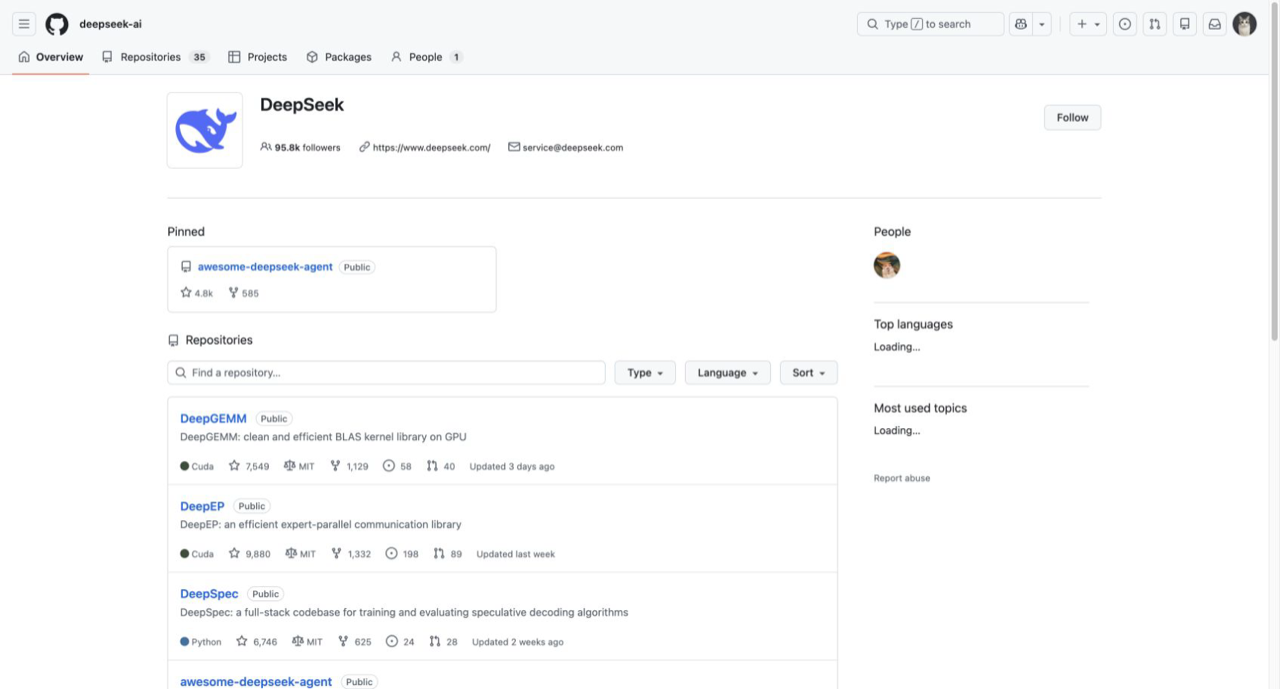
Source: DeepSeek's official GitHub organization, accessed July 23, 2026. It verifies public repositories on that date, not every strategic phrase in the transcript or future release policy.
TileLang and the attributed 1%-2% trade
The transcript describes TileLang as an alternative development layer and attributes acceptance of a roughly 1%-2% execution-efficiency loss in exchange for faster engineering. Four definitions are missing: the hand-written or compiler baseline, hardware and operator set, whether 1%-2% is a mean or goal, and how development speed was measured.
The public TileLang repository establishes that the project and its documentation exist. It does not independently establish DeepSeek's internal usage or the quoted loss. A DeepSeek paper, official repository commit, talk, or reproducible benchmark would be needed to upgrade this signal.
An engineering evaluation should freeze ten hot kernels and compare throughput, tail latency, numerical error, compilation time, developer days, and maintenance. A stable 1%-2% throughput cost may be an excellent trade if delivery shrinks from weeks to days. The same average can be unacceptable if a critical path loses tail-latency margin, memory headroom, or accuracy.
Activated-parameter discussion is not a model card
The transcript discusses a possible 150B-to-250B activated-parameter range. Mixture-of-experts terminology makes this especially easy to misquote: total parameters, activated parameters, per-token routing, training scale, and inference memory are not interchangeable. Until an official model card, configuration, weights, and technical report appear, the range remains forward-looking discussion and cannot justify hardware purchases.
Likewise, a vision-led organization is a management signal, not a release date. Interpreting long-term direction is reasonable; converting it into a promised quarter is not.
A 90-day DeepSeek signal board for pricing, coding agents, open source, and TileLang
An AI platform lead opens a 90-day board on July 23 and freezes sources each Monday. The pricing lane stores the official HTML, model IDs, cache-hit and cache-miss input, output, context, concurrency, and change time. The coding-agent lane accepts only a DeepSeek product page, API documentation, official repository, or signed release. The open-source lane records repository, SHA, license, weights, and a runnable command. TileLang requires first-party DeepSeek adoption evidence plus a reproducible benchmark. Enterprise revenue waits for company or credible regulatory and financial disclosure.
Items can be transcript-only, official-confirmed, tested, or decision-ready. Ten-month payback, coding-agent priority, 1%-2% loss, and the 150B-250B range begin as transcript-only. Current API pricing begins as official-confirmed. A fixed internal task package and joint engineering, finance, and security approval are required for decision-ready.
Every decision row needs an access date, first-party URL, saved snapshot, owner, and invalidation condition. The board pauses when price and invoice disagree, a retelling cannot resolve to the supplied transcript, a repository license changes, a model ID drifts, a benchmark omits its configuration, or two versions of a claim conflict. After 90 days, “insufficient first-party evidence” is a valid outcome; a forced migration recommendation is not.
Limitations and practical response
The core source is a third-party transcript without a DeepSeek certification, audio record, or independently reconciled wording. Tone, context, and numbers may have been edited. Official price and GitHub pages corroborate present products and repositories only; they cannot certify every line of a private exchange.
The responsible action today is to preserve official snapshots, baseline the existing API, and maintain the signal board. It is not to buy hardware against a parameter rumor, promise a migration date, or present ten months as realized corporate finance. RadarAI's DeepSeek update guide provides a reusable evidence workflow.
FAQ
Is this an official DeepSeek transcript?
No. It is an X Article published by @falali2015 on July 23, 2026. Statements remain attributed to that third-party transcript unless DeepSeek confirms them.
Has ten-month API payback been confirmed in financial reporting?
No. The official pricing page confirms current rates, not the cost scope or payback period attributed in the transcript.
Has DeepSeek released the coding agent?
Priority is a roadmap signal. Release requires an official product or model ID, documentation, billing, access, and limitations.
Is TileLang's 1%-2% loss an official DeepSeek benchmark?
The reviewed sources do not establish that. A public TileLang repository proves the project exists, not the internal adoption relationship or metric.
Is 150B-250B the next model's specification?
No. It is forward-looking discussion in a third-party transcript. Total and activated parameters require an official model card and technical report.
Sources
- @falali2015,
梁文锋投资者交流会(完整版全文), third-party X Article, published and accessed July 23, 2026. - DeepSeek API Models & Pricing, accessed July 23, 2026.
- DeepSeek API changelog, accessed July 23, 2026.
- DeepSeek official GitHub organization, accessed July 23, 2026.
- TileLang public repository, accessed July 23, 2026; it is not DeepSeek confirmation of every transcript claim.
Related reading
- Top China-Built AI Models to Watch in 2026: DeepSeek, Qwen, Kimi & More
- Qwen API pricing and access for builders: verify the model, region, and real test cost
- MiniMax long-context API evaluation: test evidence retrieval before trusting the window size
- GLM coding API evaluation for builders: test one repository patch with diff, tests, and rollback
RadarAI helps builders track AI updates, compare source-backed signals, and decide which changes are worth acting on.