Edit a Talking-Head Video with One Prompt: Pireel Turns Codex and Claude Code into Video Editors
Editorial standards and source policy: Editorial standards, Team. Content links to primary sources; see Methodology.
Last checked: 2026-07-23
Pireel exposes video editing as MCP tools. Codex, Claude Code, or another MCP client can work from a transcript, remove sections, create a storyboard, apply designed graphics and kinetic captions, switch themes, import local media, and export a review. “One prompt” describes the user's brief; the agent still executes a sequence of visible operations against a live Pireel Studio canvas or an offline cloud project.
In the July 23 snapshot, the Pireel Studio repository had about 552 stars and 42 forks and described a TypeScript, backend-free browser editor with WebCodecs export. The editor repository currently states AGPL-3.0-only. An earlier planning note that said Apache-2.0 is stale for this repository. Teams must recheck the current LICENSE before deploying, modifying, distributing, or commercially integrating it.
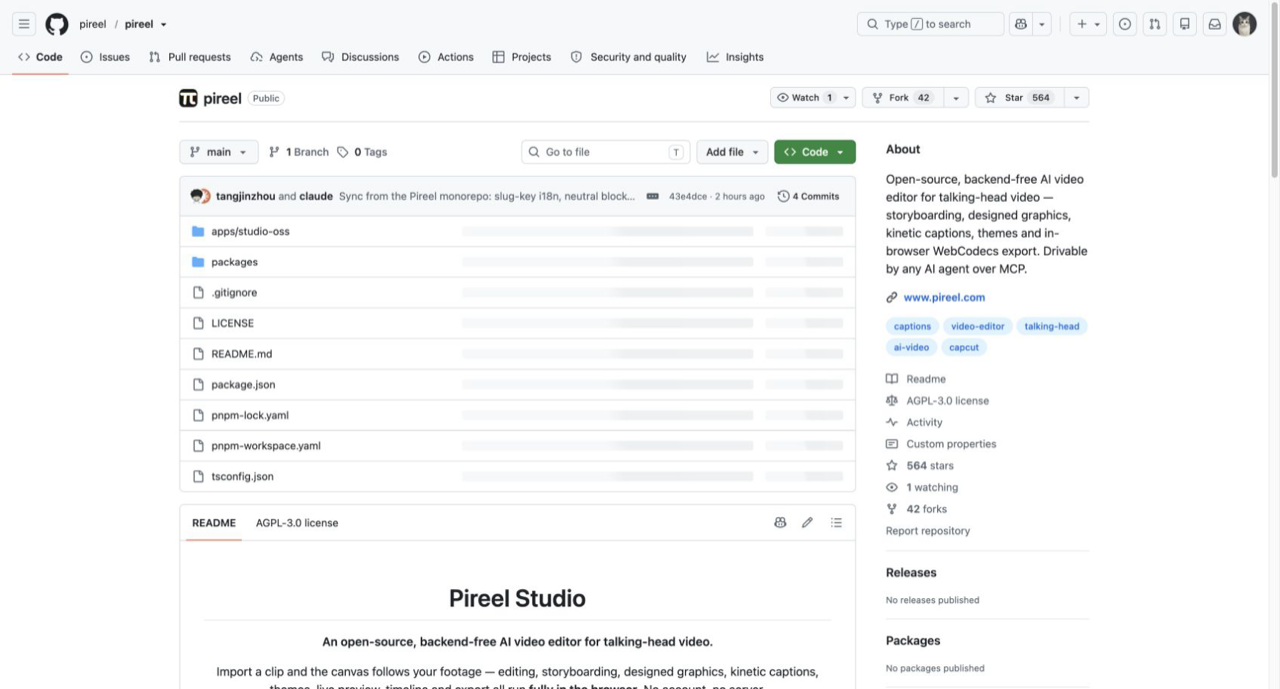
Source: Pireel Studio repository, accessed July 23, 2026. It verifies the repository's current description and AGPL-3.0-only license, not future licensing or legal suitability for a particular architecture.
Connect the agent before planning the edit
The Pireel agent repository offers a general installation through npx skills add pireel/pireel-agent. Codex users can add the plugin marketplace, install Pireel, and run codex mcp login pireel. Claude Code can register the hosted HTTP MCP endpoint. The first connection opens an OAuth flow.
# Codex
codex plugin marketplace add https://github.com/pireel/pireel-agent
codex plugin install pireel
codex mcp login pireel

# Claude Code
claude mcp add --transport http pireel https://pireel.com/api/studio/mcp
The first functional check is get_state. A composition snapshot means the agent is attached to the open Studio tab. OFFLINE MODE means it can operate on the latest cloud project without a live canvas. no cloud project means import or project creation must happen first. A workflow should gate on this response rather than discover missing state after producing an elaborate edit plan.
| State | Available work | Important limit | Use |
|---|---|---|---|
| Live canvas | Changes appear immediately in Studio | Browser tab must remain connected | Interactive refinement |
| Offline mode | Data-level tools update a cloud project | Frame-dependent tools may request the tab | Scripted rough cut |
| Local open-source Studio | Client editing and WebCodecs export | Generative providers need separate wiring | Privacy-focused deployment |
| No project | Connection tests only | No media or timeline | Import and verify first |
| Expired OAuth | Writes should not continue | Some tools may fail partway | Reauthenticate and confirm project ID |
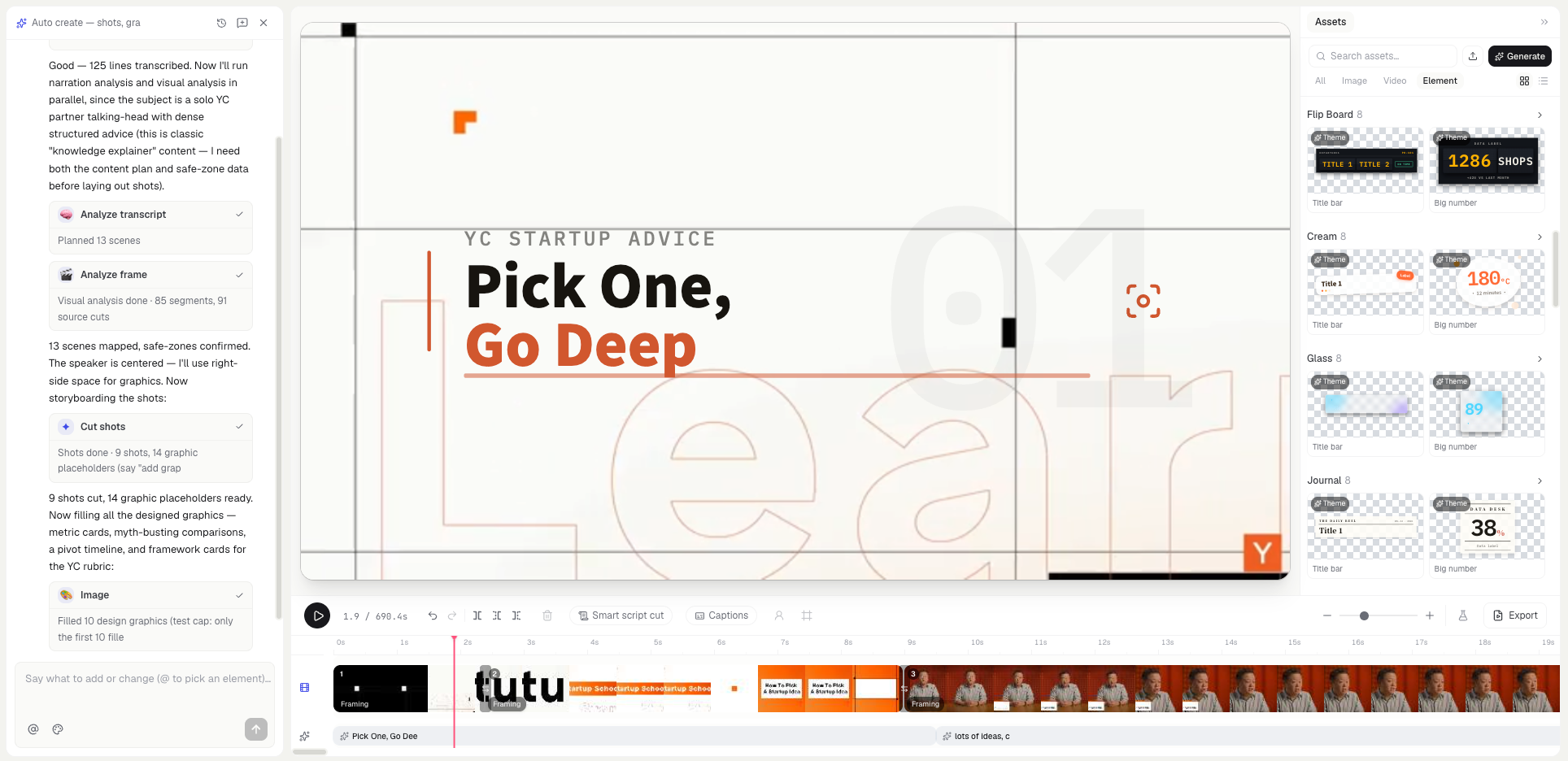
Source: Pireel, accessed July 23, 2026. The product surface shows the editing model; it does not prove that arbitrary footage becomes publish-ready without review.
Live canvas and offline mode are not interchangeable
With a Studio tab open, edits land live and the producer can inspect cuts, frames, captions, and theme changes after each important action. Offline mode keeps data-level work available against a cloud project. Operations that require video frames, the browser renderer, or certain exports can ask for the tab.
Automation should classify tools by mode. Record the starting mode, refresh state after a mode transition, and retain the project revision. If a user manually changes the canvas, the agent must fetch current state before writing again. Otherwise an old offline plan can overwrite a newer human edit.
The open-source editor stores drafts in localStorage, video bytes in OPFS, and supports client-side Chromium WebCodecs export. Its minimal shell does not make every provider-backed feature magically local. Block composition, narration planning, transcription, cloud vaults, cross-device projects, and media generation require injected providers or hosted integrations. The shell intentionally registers unavailable providers until developers wire them.
Transcript first, then structure, then visual treatment
A reliable import starts by probing file duration, dimensions, frame rate, audio tracks, rotation, and hash. The helper requires Node 20 or newer, accepts a local file of no more than 2 GB, and can use local ffmpeg to inspect metadata and transcribe audio. The 2 GB allowance is an upload boundary, not a guarantee that a low-memory browser can smoothly edit a near-limit 4K recording.
Once transcription completes, freeze the required claims, numbers, names, and phrases that must survive. Mark filler, repetition, pauses, and candidate lines using word timestamps. The rough cut should remove only sections with reliable transcript boundaries. Next map each retained claim to a storyboard block, caption, and optional graphic. Apply design and kinetic-caption treatments only after the editorial structure passes.
Captions need a separate review. Vertical video has line-length, break, dwell-time, and safe-area constraints. Editing changes timestamps, so an old caption map can drift after cuts. Every caption should resolve to a source audio span; an orphaned or paraphrased critical number needs human approval.
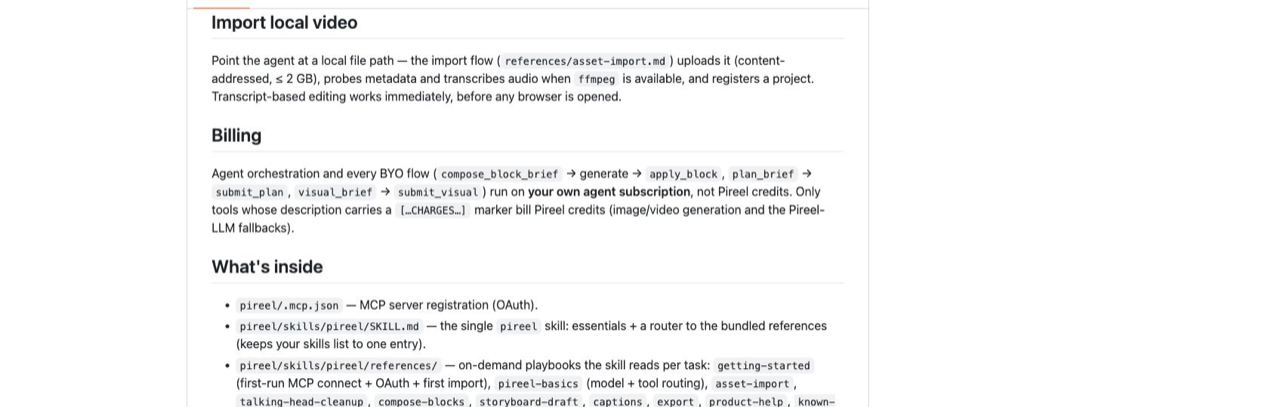
Source: Pireel agent connection guide, accessed July 23, 2026. It documents the official workflow and boundaries, not free availability of every provider or tool in the local shell.
Make charging visible before a tool runs
The agent documentation says orchestration on a bring-your-own agent subscription does not consume Pireel credits. The listed BYO patterns, including compose_block_brief -> generate -> apply_block, plan_brief -> submit_plan, and visual_brief -> submit_visual, use the user's agent. Tools whose descriptions contain a […CHARGES…] marker consume Pireel credits, including media generation and Pireel-LLM fallback examples.
That convention should become an execution rule. Before a charged call, show the tool, project, planned count, and cost unit and require approval. A retry must not silently create a second charge. Logs should retain the marker, approver, timestamp, call ID, and result. A missing marker or a billing mismatch stops the job.
Licensing also needs component scope. The Pireel Studio editor repository is AGPL-3.0-only as checked July 23. The agent connector, hosted service, dependencies, and generated media may carry separate terms. One repository license cannot approve the entire supply chain. In particular, modified network deployments, distribution, and embedding in a commercial product require legal review against the actual architecture.
Turning a 14-minute talking-head recording into a 90-second vertical cut
A producer supplies a 14-minute, 1920x1080, 30-fps Chinese talking-head recording of 860 MB and five product claims that must remain. The target is a 1080x1920 review export between 88 and 92 seconds with burned-in captions. The agent imports the file, verifies its hash and duration, and produces a transcript. Rough cutting begins only after the producer approves the required sentences and immutable numbers.
The timing budget is eight seconds for the hook, 62 seconds for five claims, 12 seconds for transitions and breathing room, and eight seconds for the closing action. The agent removes filler and duplicated explanations, reframes the speaker inside a vertical safe zone, creates one storyboard block per claim, and limits Chinese captions to 16 characters per line. Generated media remains a placeholder until structure approval so no charged tool runs prematurely.
Acceptance is exact: all five claims map back to the transcript; names and numbers do not change; a reviewer listens 500 milliseconds around each cut for clipped syllables; caption drift stays below 120 milliseconds; canvas and export are both 9:16; and only one review version is rendered. Upload failure, more than 1% missing transcription, caption drift, a dropped claim, wrong aspect ratio, or an unmarked charged action pauses the run.
The deliverable includes the MP4, input hash, transcript diff, claim checklist, timeline revision, charged-call log, and rejected examples. That evidence is what turns “one prompt” from a demo into an accountable production task.
Failure handling and rollback
On import failure, inspect the 2 GB boundary, Node version, OAuth, connectivity, and ffmpeg before uploading again. Content-addressed uploads should reuse the hash. An empty transcript should trigger an audio-only retry while preserving media, not creation of a blank edit.
If the tab disconnects, read offline state and queue tools that truly require video instead of looping. Save a revision before a batch edit, then verify project ID, duration, tracks, and required claims. Caption drift or a damaged cut should roll back to the previous revision. Export failure should preserve the project and diagnostics rather than regenerate the storyboard.
For a broader product-workflow comparison, see RadarAI's review of the most-watched AI applications.
FAQ
Can Pireel really edit from one prompt?
One prompt can define the outcome, but the agent invokes several MCP operations for import, transcript, cuts, storyboard, captions, and export. State checks and acceptance still matter.
Do Codex and Claude Code both work?
Yes. Codex has a plugin and MCP login path; Claude Code can add the hosted HTTP MCP endpoint. OAuth is part of first use.
Can it work with no browser tab open?
Offline mode supports data-level operations. Tools that need actual frames, live preview, or browser rendering may require Studio, so offline does not mean browser-independent for every action.
Does every operation consume Pireel credits?
No. BYO agent flows use the user's agent subscription. Tool descriptions marked […CHARGES…] identify credit-consuming generation or fallback actions and should require approval.
What license applies to Pireel Studio?
The main editor repository states AGPL-3.0-only as of July 23, 2026. Recheck the current license, component scope, and service terms before deployment or commercial use.
Sources
- pireel/pireel, accessed July 23, 2026.
- Pireel Studio LICENSE, accessed July 23, 2026; the main repository states AGPL-3.0-only.
- pireel/pireel-agent, accessed July 23, 2026.
- Pireel connect-agent guide, accessed July 23, 2026.
- Pireel Studio, accessed July 23, 2026.
Related reading
- Qwen API pricing and access for builders: verify the model, region, and real test cost
- MiniMax long-context API evaluation: test evidence retrieval before trusting the window size
- GLM coding API evaluation for builders: test one repository patch with diff, tests, and rollback
- Cloudflare Pay Per Crawl test guide: what publishers and AI crawlers can verify in private beta
RadarAI helps builders track AI updates, compare source-backed signals, and decide which changes are worth acting on.