Qwen3.8-Max Preview Explained: 2.4T Parameters, Token Plan, Capabilities and Release Gaps
Editorial standards and source policy: Editorial standards, Team. Content links to primary sources; see Methodology.
Last checked: 2026-07-20.
Qwen3.8-Max entered public discussion on July 19, 2026, in preview form. Key highlights include its 2.4-trillion-parameter scale, a dedicated Token Plan interface tailored for coding workflows, and the fact that the official release—and open-source materials—are still pending. At this stage, it’s essential to separately document four distinct states:
- ✅ Available for direct access
- ✅ Callable via API
- ✅ Weights downloadable
- ✅ Benchmarks reproducible
Avoid repeating vague, boundary-less claims like “the strongest model”—instead, ground every statement in verifiable facts.
Direct access
- Qwen Official Announcement Post: Original post confirming the 2.4T parameter count and the phrase “going open-weight soon.”
- Qwen Token Plan: One of the currently public entry points for the preview.
- Qoder and QoderWork: Coding- and task-oriented products explicitly named in the official announcement.
- Alibaba Cloud Model Studio Model List: For verifying official API model IDs, context window limits, and pricing details.
- QwenLM GitHub and Qwen Hugging Face: To cross-check code, model cards, weights, and licensing information.
Tested boundaries: RadarAI has confirmed all listed URLs are publicly accessible as of this date. However, no login was performed for Token Plan, Qoder, or QoderWork—and no dedicated Qwen3.8-Max API key was obtained. Therefore, this article makes no claims about generation quality, latency, or cost. Observed capabilities reflect only what is stated in official materials—and what remains unverified is clearly noted.
Capabilities, Evidence, and Current Limits
| Capability Question | Currently Confirmed | Supporting Evidence | Conclusions Not Yet Justified |
|---|---|---|---|
| Coding & task execution | Preview is live in Token Plan, Qoder, and QoderWork | Product interfaces exist—but exact permissions and model versions remain unconfirmed | Cannot claim full API availability for server-side integration |
| Model scale | Official image and post state “2.4T total parameters” | Confirms flagship-tier size—not per-token activation cost | Cannot infer inference speed, VRAM usage, or per-call pricing |
| Open weights | Exact phrase used: “going open-weight soon” | Intent to open-source is confirmed | Without weights, license, or model card available on access date, “open-sourced” is inaccurate |
| Context length, multimodality, tool use | No unified spec published yet | No RadarAI-reproducible results available | Must avoid reusing fields or defaults from earlier Qwen models |
| Benchmarks | No complete, reproducible leaderboard provided in official post | This article does not generate secondary rankings | Parameter count ≠ task performance—never substitute one for the other |
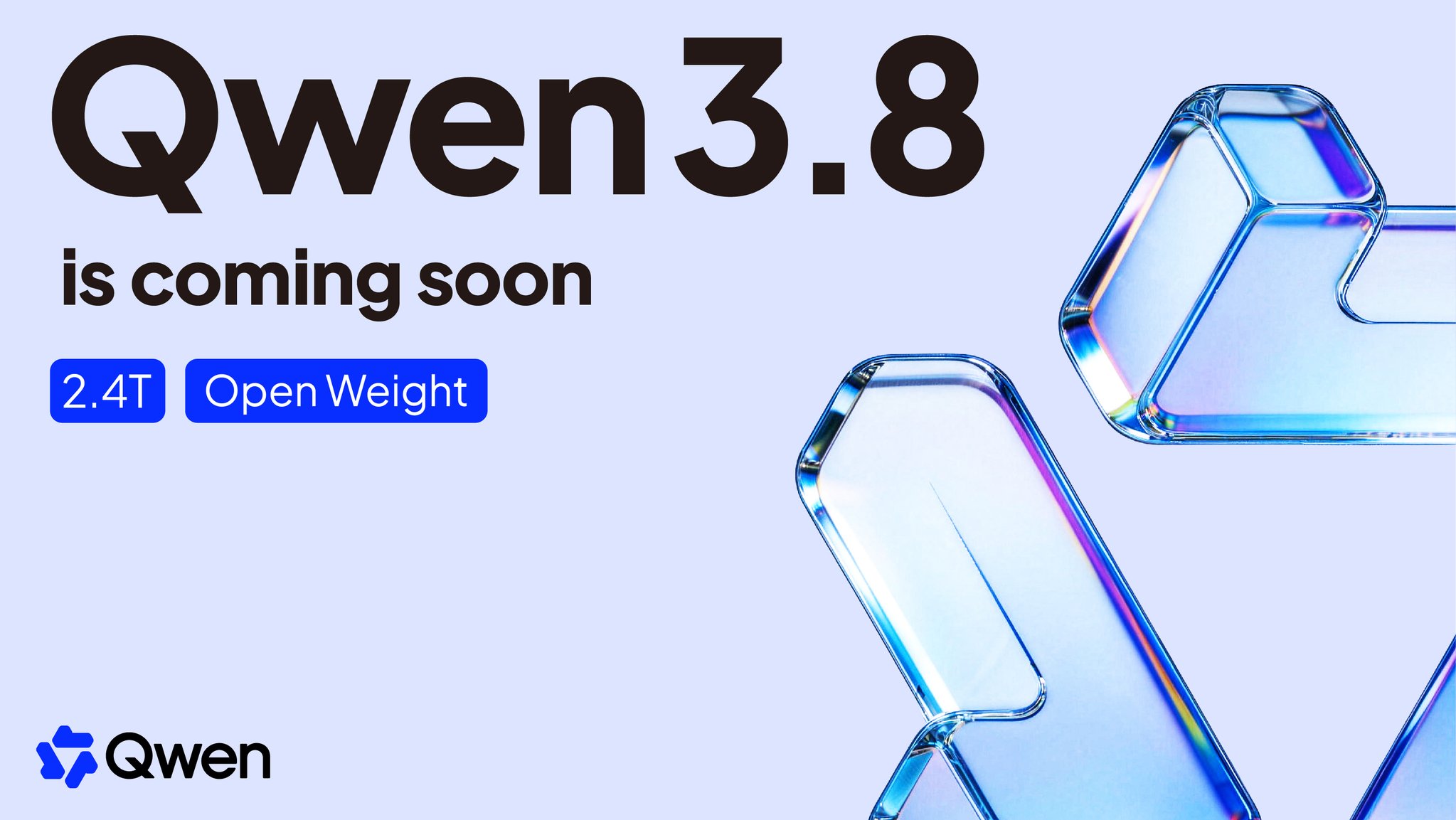
Evidence type: Official announcement image. Source: Qwen Official Announcement Post, accessed July 20, 2026. This confirms the official messaging—not RadarAI’s hands-on evaluation.
First, Clarify the Release Status
| Project | Confirmable Status as of 2026-07-20 | Boundaries to Preserve While Reading |
|---|---|---|
| Model Identity | Publicly reported as Qwen3.8-Max Preview | “Preview” ≠ official API model or long-term SLA |
| Parameter Scale | Officially stated as 2.4T total parameters | Total parameter count alone cannot determine inference cost, activated parameters, or GPU memory usage |
| Access Points | Preview launched first on Token Plan, Qoder, and QoderWork | These three product interfaces ≠ official API availability |
| Openness Status | Officially announced that the full version will be open-sourced | As of access date, “future open-source” ≠ downloadable weights today |
| Comparison Targets | Often grouped with Kimi K3 and Fable 5 in media coverage | Different product forms and benchmark setups prevent direct ranking |
As of July 20, what’s confirmed is a Preview already live in product interfaces—not a fully documented, production-ready model. The name Qwen3.8-Max-Preview and the 2.4T figure come from official sources; the preview is accessible via Alibaba Token Plan, Qoder, and QoderWork. But the official API model ID, pricing, context length, activated parameter count, license terms, and weight files remain unannounced in any single authoritative release. This boundary means: you can run hands-on evaluations now—but you cannot treat it as ready for broad commercial deployment or assume it’s already open-source.
One Launch, Three Entry Points
In its July 19 announcement, the Qwen team did three things:
- Named the preview Qwen3.8-Max-Preview and cited 2.4T total parameters;
- Integrated the preview into Alibaba’s Token Plan, Qoder, and QoderWork;
- Teased future open-weight release with “going open-weight soon.”
Alibaba chose to embed its flagship preview directly into coding and task-oriented products—so users generate real-world usage data early—while deferring formal model documentation (API specs, pricing, licenses, etc.) to a later phase.
“Going open-weight soon” must be unpacked into five concrete deliverables: model weights, inference code, tokenizer, license, and model card. A press release or product page alone—without actual weight files and an explicit license—does not constitute a complete deployment-ready package. Teams can pre-register 20 fixed tasks and baseline results against older models, then re-run them once full materials arrive—rather than committing to migration based solely on a polished demo.
What Does “2.4T” Actually Tell Us?
The 2.4 trillion figure refers to total parameters, not the number activated per token. If the final technical report discloses MoE activation patterns, accurate cost analysis must combine activated parameter count, KV cache size, context length, parallelization strategy, and service pricing. Without those details, estimating per-request cost from total parameter count alone risks off-by-orders-of-magnitude errors.
Token Plan functions more like a developer subscription or quota-based service—not a per-million-token API billing model. Teams should track: monthly fee, available models, request/token quotas, concurrency limits, overage rules, cancellation policy, and whether automated calling is permitted. A personal plan optimized for interactive coding doesn’t automatically qualify as backend infrastructure.
Benchmarking also needs layered rigor: subjective comparisons on product pages may help surface promising use cases—but adoption decisions require your own repo-level tasks, reproducible benchmark configurations (with original settings), and failure samples. For coding models specifically, measure test pass rate, unrelated diffs, command failures, manual review time (minutes), and rollback frequency.
| Evaluation Dimension | What to Record | What Not to Assume |
|---|---|---|
| Availability | Actual model ID, access interface, region, account eligibility | “Screenshot visible” ≠ globally available |
| Cost | Monthly plan fee, included quota, API unit price, overage rules | “2.4T” ≠ predictable per-request cost |
| Openness | Weight URL, license text, inference code, model card | “Will be open” ≠ “open today” |
| Code Quality | Patches applied to same repo, test outcomes, diff output, human review logs | Web demo comparison only |
| Stability | Timeout/limiting rates & output drift over 7 consecutive days | One successful run ≠ production-ready |
Why Qwen Put the Preview in Coding Workflows First
The Qwen legacy page already handles version tracking—but Qwen3.8’s search intent is far more specific: users need to know whether it’s usable now, what “2.4T” actually means, how Token Plan differs from API access, and when (not just if) migration makes sense. So this calls for a dedicated page—not cramming scattered announcements back into a broad hub. It also provides a time anchor: once the official model card and open weights appear, we’ll update this same URL incrementally—no need to create near-duplicate pages.
What the engineering team should verify on launch day (example checklist)
Ask a Python service maintainer to prepare:
- 10 real-world issues
- 5 failing tests
- 5 cross-file refactoring tasks
Run all 20 tasks twice: once with the legacy model, once with Qwen3.8-Max—using the same repo commit, prompts, and network permissions. For any write operations, use only temporary branches.
| Phase | Launch-day verification | Pass criteria |
|---|---|---|
| Prep | 20 tasks, fixed commit, baseline tests | Each has expected files + validation command |
| Execution | Log plan, commands, diffs, token/quotas, duration | Full logs; no hidden manual fixes |
| Quality | Run target + related regression tests | ≥16/20 tasks meet acceptance criteria |
| Review | Track unrelated file changes, risky commands, review time | Zero unauthorized writes; avg. review ≤12 min |
| Pause | Consecutive timeouts, model ID shifts, or unclear pricing rules | No production rollout |
This set establishes a comparable baseline for the official release. All 20 tasks must be tied to a fixed commit, validation command, and legacy-model results. When the official model arrives, rerun exactly the same tasks. If model ID, pricing rules, or tool permissions change, record before/after results separately—never carry over Preview scores directly.
Five red flags: Do not migrate when any appears
- Identity mismatch: The model name shown in the product UI doesn’t match the documented or API model ID.
- Openness failure: No weights, license, or reproducible inference instructions—yet self-hosting is claimed.
- Cost opacity: Token Plan quotas are unexplained; 20-task consumption can’t be independently verified.
- Engineering drift: Patches run but touch unrelated files—or tests aren’t actually executed.
- Stability gap: Same task yields wildly inconsistent outputs across runs, breaking review predictability.
The two most critical hard stops have nothing to do with benchmark scores:
1. The Preview name in the UI cannot be mapped to a stable, documented API model ID.
2. The official site says “weights coming soon”—but the repo, license, or model card remains missing.
Either condition means your team cannot build long-term, reproducible dependencies. Migration stays frozen.
Where the next decisive signals will appear
- Official model card: Confirms architecture, active parameters, context length, evaluation setup, and known limitations.
- Open weights: Verified via Hugging Face / GitHub under official orgs—plus license + checksums.
- Model Studio API: Final model ID, pricing, rate limits, and regional availability.
- Token Plan terms: Clear boundaries for individual/team usage, quota mechanics, auto-renewal rules.
- Third-party replication: Only results using public prompts, dataset versions, and full runtime parameters count.
Next update won’t chase parameter rumors. Instead, we’ll verify four concrete artifacts:
- Official model ID & price in Model Studio
- Weight files on QwenLM / Hugging Face
- A clear, enforceable license
- A reproducible model card
As each goes live, we’ll add its date to this page’s timeline. Anonymous screenshots or private leaderboard configs do not change the current conclusion.
What the official announcement confirmed—and what it deliberately left unconfirmed
The official Qwen account’s post on July 19 (link) provides the most authoritative primary evidence to date:
Qwen3.8 is launching and going open-weight soon, with a parameter count of 2.4T.
The preview model is named Qwen3.8-Max-Preview, and early access is available via Alibaba Token Plan, Qoder, and QoderWork.
The post also links to the Token Plan international portal.
This original text supports two key claims:
✅ “Preview is already accessible”
✅ “Open-weight release is imminent”
❌ But it does not support “weights are already published.”
The official post omits critical technical and commercial details: activation parameters, context window size, API model ID, price per million tokens, license terms, or downloadable files. When media compare the 2.4T figure with other flagship models, they often gloss over these gaps. For that reason, this article avoids benchmark rankings—and refrains from treating Qoder’s interactive experience as equivalent to formal Model Studio API capabilities. Server-side integration remains in observation mode until a stable model appears on the Model Studio model list.
The three access points also serve distinct product purposes:
🔹 Token Plan: A subscription- or quota-based developer offering
🔹 Qoder: An AI-augmented coding environment
🔹 QoderWork: A broader workflow-oriented interface
These confirm the model has entered real product surfaces—but do not automatically guarantee identical quotas, tool permissions, data retention policies, or concurrency limits across APIs. Enterprises evaluating adoption should capture separate screenshots:
- The model name visible in their account dashboard
- Their active plan page
- Sample request logs
Avoid conflating the three interfaces into a single, non-existent “product.”
This distinction also explains why testing across 20 real-world repository tasks is more valuable than generic benchmarks at this stage. Preview versions are most likely to shift in:
• Tool-calling behavior
• Long-task state handling
• Rate-limiting rules
• Output style and formatting
A fixed repository enables direct diff analysis once the official version arrives. If the final model ID changes, the weight license restricts commercial use, or unrelated diffs spike significantly on the same task, teams should retain the preview version—even if total parameter count increases.
On launch day of the official release, save fresh snapshots of:
• The official announcement post
• The Model Studio model list
• The Hugging Face weights repository
If dates or descriptions across these three sources conflict, defer to the product-layer description each source explicitly provides.
Evidence type: Official webpage screenshot. Source: Qwen on Hugging Face, accessed July 20, 2026. This page helps verify whether weights have actually appeared—but the image itself does not prove Qwen3.8-Max weights are live.
Frequently Asked Questions
Has Qwen3.8-Max been officially released yet?
As of this snapshot, all public channels and reports explicitly label it a “preview.” The official release—and full open-weight materials—await formal confirmation.
Does “2.4T parameters” mean higher cost?
Not necessarily. Cost depends on activated MoE parameters, service optimizations, context length, and pricing—not just total parameter count.
Can Token Plan replace the API?
No. Subscription-based coding interfaces differ from server APIs in concurrency limits, quota allocation, terms of use, and SLA guarantees.
What should we test right now?
Prioritize real-repo metrics: patch correctness, test execution success, irrelevant diffs, tool-calling reliability, and manual review effort.
When is migration safe?
Only after the official model ID, pricing, and usage limits stabilize—and the model passes your fixed regression suite consistently—should you begin small-scale, gradual rollout.
Official & Primary Sources
- Qwen Official Announcement Post: Mentions “2.4T”, “Preview access”, and “going open-weight soon”
- Qwen Token Plan: Official international pricing and subscription portal
- Alibaba Cloud Model Studio Model List: Authoritative source for API model names, context lengths, and pricing
- QwenLM GitHub: Official code repositories, model releases, and license information
- Qwen on Hugging Face: Official model weights and model card hub
All pages accessed on 2026-07-20. News outlets were used only to verify event timing and public statements. For version numbers, parameter counts, access endpoints, corporate identity, and scheduled activities, official pages take precedence. Details unavailable on those pages are explicitly marked as pending verification—no assumptions or inferences are drawn from search snippets.
Read next
Related reading
- Qwen API pricing and access for builders: verify the model, region, and real test cost
- Kimi Pricing and API Access for Builders
- Kimi Code CLI and IDE Evaluation for Builders
- How to Use the DeepSeek API for Builder Workflows
RadarAI helps builders track AI updates, compare source-backed signals, and decide which changes are worth acting on.