RedNote's dots.note-3.0 Scores a Perfect IMO: The First AI Model to Do It
Editorial standards and source policy: Editorial standards, Team. Content links to primary sources; see Methodology.
Last checked: 2026-07-23
RedNote's dots.note-3.0 has been reported to score 42 out of 42 on the six problems from the 2026 International Mathematical Olympiad. That is a notable result for long-form mathematical reasoning, but the useful version of the story is narrower than the celebratory shorthand. The system did not sit the official human competition. It was evaluated on the problems after they became available, under a model-specific protocol whose prompt, tools, sampling policy, and grading record are not yet fully public.
China Daily and the South China Morning Post both frame it as the first AI model to achieve a flawless score in this setting. This article uses that reported scope. It does not turn “first on this six-problem evaluation” into “best at every kind of mathematics.”

The captured result surface, accessed July 23, 2026, documents how 42/42 was presented publicly. It does not reveal hidden reasoning traces, tool calls, or how many attempts were generated.
A perfect IMO score is a protocol, not just a number
The IMO has six proof problems, each worth seven points. Human contestants work under fixed time and information constraints. A post-competition model run needs its own equally explicit rules: the exact problem text, system and user prompts, network access, code execution, output limit, number of samples, retry policy, answer selection, and grader rubric.
The IMO problem archive establishes the official source material. The 2026 results page establishes the human competition record. Neither page certifies a vendor's later model evaluation, so the two records must not be blended.
| Question | What the public snapshot supports | What remains unproven | Decision |
|---|---|---|---|
| Problem set | The six 2026 IMO problems were the reported target | Exact language and prompt formatting | Re-run from archived inputs |
| Score | A reported total of 42/42 | Perfect performance on every sample | Request all candidate outputs |
| “First” | First under the comparison used by named reports | Exhaustive priority across private evaluations | Keep the claim locally scoped |
| Tools | No complete public execution manifest located | Tool-free or offline execution | Withhold independent certification |
| Availability | The system is named dots.note-3.0 | A public checkpoint, stable API, price, or model card | Do not invent an access guide |
This distinction is not pedantry. A model that produces one valid proof in 64 samples is useful for exploration, while a model that submits one valid proof under a fixed budget is stronger evidence for dependable reasoning. Both results can be reported, but they answer different questions.
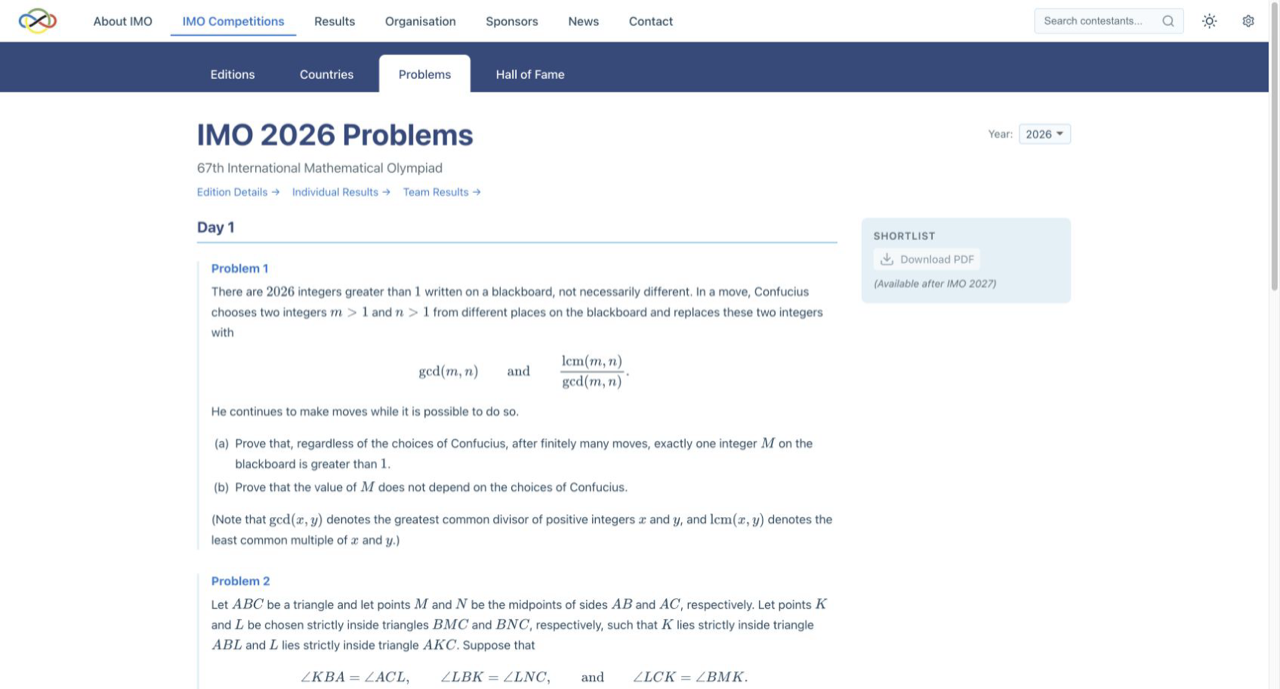
Source: International Mathematical Olympiad problem archive, accessed July 23, 2026. It proves the origin of the problems, not the prompt or evaluation configuration used by RedNote.
What a six-problem evidence record should contain
For each problem, an audit-ready record needs five layers. First is the input: source document, language, mathematical notation, and a hash of the rendered prompt. Second is execution: model version, timestamp, temperature, seed when available, context and output ceilings, timeout, and declared tools. Third is selection: every candidate, the retry trigger, and the rule that chose the submitted answer. Fourth is grading: two initial scores, written reasons, and an adjudication result. Fifth is provenance: immutable run IDs and files that another evaluator can inspect.
Proof grading cannot be reduced to asking another model whether an answer “looks correct.” Reviewers should separately mark the central construction, supporting lemmas, coverage of edge cases, logical transitions, and final conclusion. An elegant paragraph can hide a missing implication; an awkward proof can still be complete. Graders therefore need mathematical competence, blinded model identity, and a rubric fixed before seeing the outputs.
A compact schema might include problem_id, prompt_hash, attempt_no, answer_hash, network_log, tool_log, grader_a, grader_b, adjudicated_score, and failure_class. That schema also preserves negative evidence: empty answers, timeouts, unproved theorems, ambiguous notation, or proofs that reach the right result through an invalid step.
How far the “first model” claim travels
The defensible claim is that named reports identify dots.note-3.0 as the first AI model to post a perfect result on this 2026 IMO evaluation. It is not a general certificate of mathematical supremacy. Different years, prompt languages, tool access, sample counts, and grading policies create different comparisons. Research mathematics, formal proof, interactive theorem proving, and routine quantitative work are also distinct task families.
There is a second boundary around availability. As of this check, the material reviewed for this article did not establish a downloadable dots.note-3.0 checkpoint, public production API, price sheet, complete model card, or reproducibility repository. The absence of those artifacts does not negate the reported score. It does mean readers cannot yet reproduce the vendor run or make a procurement decision from an official service specification.
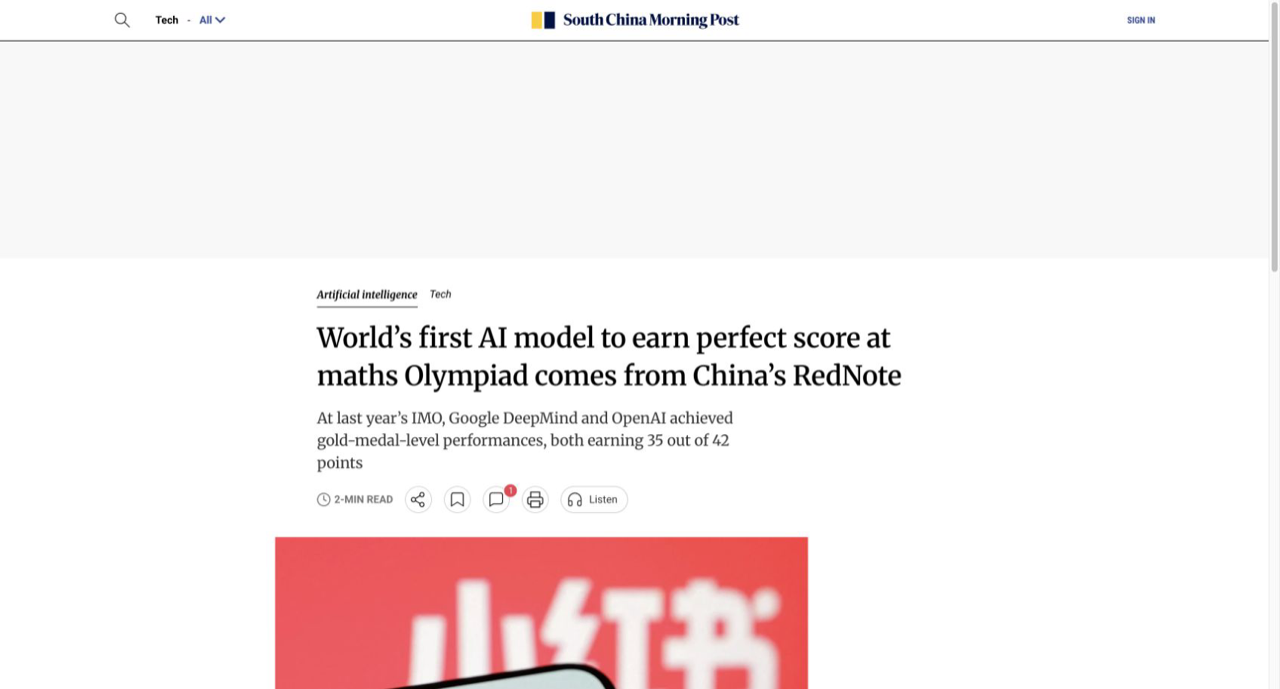
The report capture, accessed July 23, 2026, verifies the wording used by named publications. It is not an independent run log and does not establish public model availability.
The gaps that matter for reproducibility
Four missing groups should be tracked. Input gaps cover prompt text, translations, and system instructions. Execution gaps cover internet access, code tools, sample counts, retries, and final-answer selection. Grading gaps cover reviewer identities or qualifications, per-problem notes, and disagreement handling. Model gaps cover the exact build, inference budget, and whether a moving service or frozen artifact produced the answers.
These gaps support a practical evidence ladder. A named score is reported. Public answers that independent experts can re-grade are auditable. A frozen model, fixed prompt, container manifest, and repeated matching result are reproducible. The current conclusion belongs on the first rung and may move upward when additional artifacts appear.
Six-problem rerun with two graders and a fixed retry budget
A mathematical-reasoning evaluation lead builds a package from the official English problems and a separately checked Chinese rendering. Every equation is normalized to the same LaTeX representation. The model runs in a network-disabled container with no Python, search, or theorem library. Each problem receives the same system instruction, a 90-minute wall-clock cap, and 32,000 output tokens. After the first answer, one fixed “review and correct your proof” message is allowed; researchers may not improvise follow-up hints.
Two olympiad-capable graders score each submission from zero to seven without seeing the model name or the other score. A difference above one point goes to a third adjudicator using the prewritten rubric. All attempts remain in the record, including the one not selected. The pass gate is an adjudicated 42/42, exact agreement by the first two graders on at least five problems, and three complete reruns without raising the retry allowance.
The experiment stops immediately if a candidate output is missing, graders dispute the central validity of a proof, or the container records undeclared network or tool activity. In those cases, the team can publish per-problem observations but cannot claim to have reproduced the perfect run. This is deliberately stricter than a demo because the headline result is unusually strong.
Limitations and practical use
Six problems are a tiny sample. Once the problems and solutions circulate, later evaluations also face contamination risk. A faithful 42/42 reproduction would demonstrate capability under one controlled setup, not guaranteed reliability on unseen olympiad sets, formal verification, university mathematics, or a lower inference budget.
Research teams can reasonably place dots.note-3.0 on a watchlist and request the evaluation package. Product teams should wait for an official access surface and test against their own acceptance tasks. Readers building a broader evaluation can use RadarAI's benchmark verification guide to keep benchmark evidence separate from deployment evidence.
FAQ
Did dots.note-3.0 officially compete in the IMO?
No. The accurate statement is that the model was evaluated on the six IMO problems and was reported to score 42/42. The human competition and a later model evaluation are separate records.
Does 42/42 mean every generation was correct?
Not without sample and retry records. A final perfect set does not disclose whether it came from one attempt per problem or selection across multiple candidates.
Is “the first AI model” a usable claim?
Yes, when it stays attached to the evaluation scope used by the named reports. It should not be generalized to every model, year, mathematical field, or private test.
Can developers access dots.note-3.0 now?
The reviewed sources did not establish a public checkpoint, stable API, price sheet, or full model card on July 23, 2026. This article therefore does not offer invented setup instructions.
What is the minimum credible rerun?
Freeze the six inputs, prompt, permissions, inference and retry budgets, and extraction rules; retain every trace; use two independent graders; and define disagreement and stop conditions before execution.
Sources
- China Daily, “Chinese AI model sets record with perfect score”, accessed July 23, 2026.
- South China Morning Post, “RedNote’s AI model is first to achieve flawless score at maths Olympiad”, accessed July 23, 2026.
- International Mathematical Olympiad problem archive, accessed July 23, 2026.
- International Mathematical Olympiad 2026 results, accessed July 23, 2026.
Related reading
- Qwen API pricing and access for builders: verify the model, region, and real test cost
- MiniMax long-context API evaluation: test evidence retrieval before trusting the window size
- GLM coding API evaluation for builders: test one repository patch with diff, tests, and rollback
- Cloudflare Pay Per Crawl test guide: what publishers and AI crawlers can verify in private beta
RadarAI helps builders track AI updates, compare source-backed signals, and decide which changes are worth acting on.